Crawl Across the Ocean

Monday, August 08, 2005

Sword of Damocles

Alan, from Gen X at 40, talks a bit about blogging today, but the part that alarmed me was his conclusion:
"And isn't it significant that there has not been a really bad movie - not a movie at all in fact - about blogging like email's 1998 You've Got Mail or that 1983 video game based classic WarGames?"


Now that Alan has brought it up, I suspect that it is almost inevitable that, at some point, a movie will be made about blogging. Now if it was just a film adaptation of Ender's Game, I could live with (even welcome) that, but I'm guessing it's going to be far more painful.

Some potential ideas:

Romantic Comedy

'You've Got Comments' - A winsome urban girl with a funky blog about problems with the local telecommunications company falls in love with a guy who leaves lots of witty comments on her site. It turns out that he is a telecom exec who is in charge of the lobby group which eventually gets all ISP's to block access to her site. She shuts down her blog, goes off to live with the telecom guy and they all live happily ever after.

-----

Political Thriller

'The Blog Identity' - The President of the United States, a handsome, likeable man, swept to power on a progressive anti-corruption platform. But since taking office he has led the country into a military quagmire based on a pack of lies and deception, severely damaged the reputation of the once great U.S. of A. around the world, created a huge financial mess domestically, run rampant over the poor and the environment, appointed partisan corporate hacks to key positions of responsibility and generally been a huge disappointment. But, thanks to his political party's control of a submissive media, the public remains apathetic or even endorses his dangerous regime.

Then a new blog suddenly appears which seems to have access to insider information at the highest levels. The new blog begins fingering people around the President (the sell-out Vice President, the arrogant Secretary of Defense, the smear-tactic specialist political advisor). The media tries to ignore the new information but, despite their efforts, a feisty, ambitious, young (and beautiful) prosecutor is appointed to head a grand jury and start investigating the corruption. As the people surrounding the president start to get subpoenaed and one even goes to jail, they desperately hunt to find out who is running this new blog and where it is getting all its inside information.

The prosecutor gets closer and closer to her ultimate goal of bringing down the president himself, even as she finds herself falling in love with him (the president's wife died 2 years earlier) and wondering how he can go along with such terrible policies. Finally, we find out the truth, the blog is being run by the President's (incorrigible) 12 year old son. It turns out that, after his wife died, the president was so depressed that he allowed himself to be used as a figurehead to front for a corrupt cabal who only wanted power to serve their own selfish needs.

Once he saw the damage the policies were doing, the president wanted to change course, but he was in too deep and his cronies threatened damage to him and his family if he stopped following orders or said anything to anyone. With no other options, the President began confiding damaging secrets to his son, the only person he could communicate with without being eavesdropped on, and his son ran the anonymous blog.

In the end, the cronies are all thrown in jail, the president resigns in a tearful press conference to make way for the one honest member of his administration and he goes off to the ranch to live happily ever after with the prosecutor.

Because there can never be too many movies about the American president.

-----

Canadian / Foreign - rural:

'Margeret's Musings' - A bright teenage girl is frustrated by the dead-end resource-based little town she lives in, the stupid mistakes the people make in their lives there and the fact she is not likely to ever escape to the big city and pursue her dream of becoming a writer.

In frustration she starts an anonymous blog which begins revealing some of the town's silly secrets and offering thinly veiled advice to town members. The people are upset about this nosy blog upsetting people's lives but, at the same time, once the secrets come out and people start taking the blog's advice, the town's old quarrels start to get resolved, people being to solve some of their personal problems and the people who are 'meant' to be together start to move towards ending up together.

Buoyed by success, the blog writer tries to use her blog to lure a handsome, sophisticated new stranger in town (from the big city) to fall in love with her, but foolishly resorts to the same silly deception and secret-keeping that she derided in others. All her efforts backfire and she ends up turning the handsome stranger against her, seemingly for good, as he decides to leave town. At the same time, her secret is exposed and she feels the wrath of her fellow townspeople.

The blogger confronts the handsome boy before he can leave town and tells him the truth and he confesses that he was secretly in love with her too. Not only that but his mother works as an editor for one of the big Toronto newspapers and he had told her to read the blog. Based on the quality of the writing in the blog, the editor wants the blogger to come to Toronto for an internship. Nothing big, but possibly the start of a promising career, and of course the handsome boy lives in Toronto too (and the townspeople realize how much she has helped them and forgive her).

-----

Canadian / Foreign - urban (not rated):

'Sallow' - A number of strange characters who all happen to live in the same neighbourhood each run their own blogs. A seemingly happily married middle aged family man runs a blog about the local gay sex scene. A disaffected teenage boy writes a blog about sailing. A mysterious teenage girl runs a photoblog of pictures taken in and around the neighbourhood. A young couple blogs about their home renovations. A woman runs a blog which covertly passes on key times and dates for people running a human smuggling ring which tries to bring in refugees from failed states abroad.

The various characters have some random encounters which don't lead anywhere. There is gay sex. Many melancholy looks are exchanged. The blogs are only tangentially related to the story. In the end, nothing much really happens, but the disaffected teenager leaves town to head for the sea.

-----

Your turn - what would the plot be if you were making a movie about blogging? Or, if Hollywood was making a movie about blogging what would you expect / hope for?

Labels: , , , ,

Friday, July 22, 2005

Citizen Journalists?

Readers will likely know Antonia Zerbisias as the proprietor of the blog, Azerbic, but may not realize that she also has a regular column in the Toronto Star newspaper. In a recent edition of said column, she talked about the idea of citizen-journalism:
"We're a long way away from true participatory journalism. ... Not until "citizen journalists" do the tedious slogging through court records. Not until they attend news conferences and do interviews. And maybe not even then.

Don't get me wrong. I'm all for citizen journalism. I have been agitating for it at the Star a long time, urging editors to hire or link to local bloggers, open up the process and let readers in.

Give the people access.

Because the bottom line is, journalism is about access. Access to information. Access to newsmakers. Access to the airwaves. Access to the means of distribution. And last but far from least, access to pictures."


Now as I see it, there are three stages of providing information to people (i.e. doing 'journalism'): Information gathering, information transcribing and information distribution.

The first step of gathering information has been vastly democratized by the internet. Whether it is the federal budget, the latest Statistics Canada report, the latest think tank study, the movement of the stock market, the latest poll or election results, the weather forecast or the stories on the newswire, this information is available to the citizen as never before. My long, slowly moving process of adding dropdown boxes to my sidebar has been an attempt to group together all these 'sources of information' for easy reference.

Of course not all useful information is published on the internet. Paid journalists typically have access to more information sources such as personal conversations with contacts on their 'beat', attendance at ceremonies, speeches, conferences etc., greater access to prominent people for interviews as well as being on the receiving end of press releases from various organizations.

The one advantage citizen journalists have (as a group) is strength in numbers. It is simply more likely that a 'citizen journalist' will be in the right place at the right time to experience / get a photo of a tornado or a terrorist attack. It is also more likely that a 'citizen journalist' will have specialized knowledge on some topic. Why read columnists in the Star or Globe regurgitating Michael Geist's take on the latest developments in intellectual property in Canada (of course Geist has his own column in the Star as well), when you can read what he has to say for himself directly? Why read some columnists interpretation of the latest news on global warming when you can get a take from an actual climate scientist at RealClimate?

The second step is to sift through all the information available, figure out what is important and make sense of it. Of course if you are just taking pictures of a tornado with your cellphone and sending them off to the local paper, this isn't so important. But if you a blogger (or a podcaster or a videocaster) then your ability to choose topics and to write (or speak) well is the most important aspect of what you do.

Typically, journalists have some sort of training in their field such as attending journalism school, being sent on courses by their work, learning from colleagues at the office or what have you. But, based on what I've seen, I'm not really convinced that this consistently translates into superior writing. I'm guessing that if I focussed on writing a couple of fairly short pieces a week, and was supported by an actual editor, you could slip my columns into most newspapers and nobody would say, 'hey that guy's writing isn't up to the usual journalist standard, he must not be trained as a journalist!'. And there are many, many bloggers out there who are much better writers than I am.

With video or audio transmissions there might be the odd issue with production values, but for the written word this doesn't seem to be much of an issue. Most blogs I know are just as easy on the eyes (if not more so) than your typical online 'mainstream media' outlet. Even for audio and video what barriers are left are falling fast.

So I don't think there really any significant obstacles to citizen journalism in the transcription step. If anything, many citizen journalist sites (Hullabaloo comes to mind) probably thrive because they are so much better written than most of what you find in the mainstream media.

The third and most troublesome area is distribution. Things are starting to open up with digital TV and radio but there is still a lot of inertia from the era when bandwidth limitations meant that only a chosen few companies had access to transmission of audio and video, and production costs ensured that the whole operation had to be staffed by salaried employees. Similarly, the natural convenience of having print information bundled together into an easy to handle package led to the formation of newspapers and magazines which again led to the hiring of full time staff members devoted to providing content.

Not having a non-journalist 'day job' is of course a big advantage in that it gives you a lot more time to both gather and transcribe information. I think an important milestone has been reached in that, in the U.S., blogging has become popular enough that some of the most popular bloggers are actually able to make a living at it. Of course, over time, we may find that the blogging world solidifies and starts to become as structured as the mainstream media. Perhaps in the future a blogger will start out their blogging career by submitting trial posts to the big name group blogs and hoping to get taken on as a writer for them. Or perhaps big 'brand name' sites like DailyKos will aggregate content, giving more exposure to anything which is recommended by enough readers.

Or perhaps blogging will be just a fad and will fade away leaving the same old mainstream media plugging along as always, just now online as well as on paper (or on air), but I somehow doubt it. Individual bloggers will come and go of course but I suspect there will always be lots of people interested in putting their thoughts out there for the world to see. And, as the old concentrated distribution models break down, the mainstream media will be able to afford fewer correspondents, fewer staff writers, fewer editors - that is, they will be less competition for citizen journalists and they will drive readers to seek out bloggers who are writing about the specialized topics people are interested in.

I myself first came across Jim Elve's BlogsCanada site because I was searching for information on the Green Party in the lead up to the last Federal election and couldn't find anything more than a couple of 'Hey the Green Party exists' columns in the mainstream media. I'm guessing this desire for specialized information is only going to continue to increase as new generations grow up expecting google to have both an answer for every question and an insightful (or at least animated) discussion of every topic.

So it's nice that people like Zerbisias are working to get the barriers knocked down a little faster but, given the trends in access to information, access to transcription tools and ability to distribute content widely and cheaply, I'd say the days of the citizen journalist are coming sooner or later, no matter what anybody does (short of destroying economic and technological progress that is). The biggest risk (as I see it) is that this new generation of citizen journalists may not have the same skillset (or resources) to follow trails, sniff out deception, dig up the truth and follow a paper or money trail that today's career, professional journalists do. And that means that stories which require a lot of background work may never get written. It's a risk, but I'm optimistic. It's a big world with a lot of people and I'm guessing that there will be those willing and able to do this kind of forensic reporting no matter what the structure of the market is.

It should be interesting to see what happens anyway - especially since I'm not someone who currently makes a living as a journalist.

Labels: , , , ,

Sunday, April 17, 2005

This Post Worth Reading 19 Times Out of 20

With B.C. heading to the polls in one month (vote yes!), and Federal politics in a state of uncertainty, potentially leading to an election sometime this year, I thought this would be a good time to add another dropdown box, this time with Canadian Polling firms in it (if I missed any important ones, drop me a line).

Like with many topics, it seems, I have mixed feeling about polls. On the one hand, I'm a numbers person with a bit of a stats background, so I enjoy digging into poll results to see what can be made of them. On the other hand, I find that polls feed into the 'horserace' mentality in which all people care about is whose numbers are good and whose are bad, rather than looking at actual issues. Furthermore, because the general population often seems to be a little lacking in its ability to interpret numbers, statistics tends to be an area where unscrupulous people will try to manipulate the numbers to suit their point. And in no area of statistics is this more true than in regards to polls.

The most common way to manipulate a poll is through the structuring of the questions. The pathetic B.C. referendum on native issues was a classic example of how to write a question to get the answer you want to hear. If this fails, the second line of defense is to interpret the results in a way which isn't consistent with the answers received. My recent post on my STV blog, is a good example where the 'lead' headline from a poll gave the opposite result from the poll results themselves.

Another problem with polls is that people try to interpret small movements which could well just be random fluctuations. This is especially true when the numbers are broken down into regions or different demographic groups which typically have much higher levels of uncertainty than the national totals.

There is legislation which outlines disclosure requirements for polls but as this article by Claire Durand, Professor at Université de Montréal shows, compliance with these rules is inconsistent at best. Of course I'm not sure how much good these rules do since I'm not sure people really pay attention to the poll fine print anyway.

Even if the pollsters are doing their job honourably and competently (as many are) and the media is interpreting the results clearly and objectively (this happens every now and then) there are still issues with polls. One of the biggest is the continuing rise in refusal rates. Veteran pollster Angus Reid refers to high refusal rates as polling's 'dirty secret' in this worthwhile article on polling in the Tyee. Besides increasing costs and putting downward pressure on sample sizes, this potentially biases the results if the refusal rates are different for different parties. Reid figures the solution is for the media to spend more on polling (shocking!) to make sure they get things right and notes that in the era before polls became prevalent, people were still devoting a lot of effort into 'horserace' politics and attempts to predict the outcome.

So far, there's no word on the possible rise of a new generation of pop-culture-referencing-smart-asses who are happy to talk to pollsters and just make up false answers as they go along (count me in with this group) and how that could skew the results.

It's been a rough year for the pollsters. They completely failed to see the Liberal minority government coming and down in the U.S. the massive discrepancy between the exit poll1 results and the vote count still has not been resolved half a year later.2

Looking to the future, it seems like times will only get tougher for the pollsters. While on the one hand our growing demand for up-to-date information will drive more and more polling, our growing reluctance to talk (honestly) to pollsters will make it harder for them to get accurate results. People are already skeptical about relying too heavily on poll results or trusting media interpretations of poll results and this isn't likely to help. Darren's negative reaction to polling (which proved justified when the results came in in the Federal election) may become increasingly common. Polls make for good amusement in the punditocracy but their usefulness in the real world is pretty limited. If nothing else, I recommend taking all poll results with a grain (or two) of salt.


----------------
If you're interested in polling and recent Canadian polls, here are some links:

HillWatch's polling station which has a good historical log of political polls.

Maple Leaf Web has a really good FAQ (list of Frequently Asked Questions) on the topic.

CRIC has a great archive of polls organized by polling company

Michigan State University's Canadian Studies Centre has a dated (but still useful for those companies which are still around) list of polling companies with descriptions of each one.

----------------------

Polling companies tend to match up with media outlets:

Typical pattern is:

Environics = CBC
Ipsos-Reid = Globe and Mail / CTV
SES Research = Toronto Star / Sun Media
COMPAS = National Post / CanWest

although there are certainly exceptions and this can change as contracts/relationships end.

----------------------


1 Exit polls are polls conducted as people are leaving the voting station. Because they record what people actually voted (of they are honest) as opposed to just who they are going to vote for, exit polls are generally much more accurate than pre-election polls.

2 The firm responsible for the exit polling released a report on what went wrong which said that, "Our investigation of the differences between the exit poll estimates and the actual vote count point to one primary reason: in a number of precincts a higher than average Within Precinct Error most likely due to Kerry voters participating in the exit polls at a higher rate than Bush voters.".

But they didn't really do any analysis to back that up and as this report shows, their explanation doesn't really hold water: "Edison/Mitofsky did not come close to justifying this position, however, even though they have access to the raw, unadjusted, precinct-specific data set. The data that Edison/Mitofsky did offer in their report show how implausible this theory is."

Labels: ,

Wednesday, April 13, 2005

The View From Here

I mean that title figuratively, but also literally, since the picture above is the view from my apartment. Which tells you a couple of things. One: I have a lousy view1 and two: Gas prices are pretty high compared to the last few years.

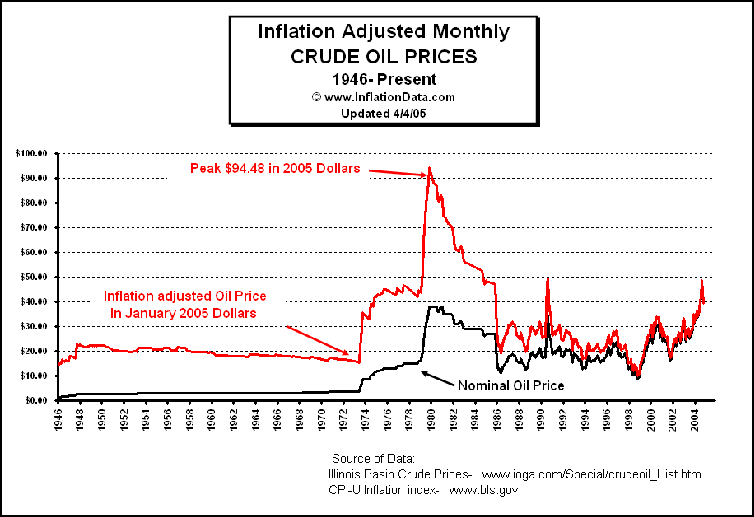
Now, I know what you're thinking - 'sure they seem high, but aren't they pretty low once you adjust for inflation' - OK maybe you weren't thinking that, but some people were, I'm sure of it. Anyway, this chart shows the historical price of oil in inflation adjusted terms and you can see that, aside from the spike caused by an arbitrary decision by OPEC to reduce supply in the 70's, oil prices are looking pretty high, even after adjusting for inflation.

Mahigan over at True North has a post up which looks at 'peak oil' and some of it's potential consequences. The basic idea behind peak oil is that one of these years were going to hit an all-time peak in terms of oil production and after that oil production will begin to decline (because we've already extracted so much of the easy-to-get-to oil).

In fact, there's little dispute that this will occur sooner or later but where people differ (besides the sooner vs. later part) is on what the impact will be.

On one side we have the optimists. While they don’t deny that we are beginning the long process of running short on traditional fuel supplies (oil & gas), they believe that human ingenuity combined with pricing signals from the market will ensure an orderly transition. Count Alan Greenspan among this group. Optimists will point out that civilization has made it this far without hitting any resources constraints and that every previous time people have predicted some sort of resource crisis, they have turned out to be wrong. Basically they figure that if supplies of oil and gas get short the price will rise and people will figure out ways for our economy to keep on running with less oil and gas.

On the other side are pessimists such as James Howard Kunstler (quoted extensively in Mahigan’s post) who believe that the coming oil crunch will cause a drastic change in our lifestyles with car-dependent fully-detached suburban living no longer being viable for the middle class in a world of sky-high fuel prices. The geo-political pessimistic viewpoint sees the war in Iraq as just one example of what is likely to become an ever more desperate and high-stakes battle among the world’s most powerful economies to secure their share (and more) of what remains of the world’s oil supply.

Besides optimism/pessimism, another way to look at the situation is from a demand/supply perspective. As we can see here, worldwide oil consumption (demand) has been on a steady upward climb throughout recent history. The pessimistic view says that as huge, developing nations like China and India industrialize, we can only expect this consumption to keep climbing even if oil consumption in the developed world were to level off or decrease due to increased prices. The pessimistic view acknowledges that higher prices will lead to cutbacks in oil and gas use, but figures that prices will have to go high enough to cause crippling economic conditions before any significant changes will be made.

The optimistic view figures that human ingenuity and resourcefulness will find ways for us to easily lower our consumption if this proves necessary (true optimists don’t think it will be). Reasons for optimism on the consumption side would be technological advances which allow us to do the same things using less oil and gas (hybrid cars, led lights, efficient appliances, better insulation, etc. etc.), the colossal amounts of energy we currently waste at the consumer level (leaving room for relatively painless cutbacks), the fact that Europe manages a competitive quality of life using much less energy than North America, and the decreasing energy intensity of the economy (ratio of energy used to gdp) which show that energy use is making up a smaller % of our total economic activity over time.

More attention is generally shown to the production side. Generally, we get energy either from oil, gas, coal, hydro or nuclear (wind, while growing fairly rapidly, does not meet a significant % of our energy needs, and is unlikely to ever get beyond 5-10% of total energy supply). At best, oil and gas will require us to undertake ever more expensive efforts to ensure a steady supply. For example, building massive terminals to receive gas from overseas or drilling for oil in remote/environmentally sensitive areas or undertaking the huge costs of pulling oil out of the Alberta tar sands. At worst, even these efforts will be inadequate and prices will continue to rise faster than inflation.

There’s no shortage of coal in the ground, but if you’re worried about global warming, or if you live in Toronto and miss the sky during the summer, or if you happen to know one of the (estimated) thousands of people who have died prematurely do to air pollution caused by coal, you may not be too excited about the world making a big switch back to (or even continuing to use) coal as a primary fuel. The optimistic view is that innovation will find ways to burn coal without releasing carbon (or mercury or anything else nasty) into the environment, but while progress has been made (especially with regard to acid rain) there’s still a lot more work to be done and no guarantee that it will be successful (at a reasonable price). Also, if you consider the history of energy use from wood, to coal, to oil to gas the historical trend has been toward sources containing less carbon, not more.

Nuclear power represents another option. Here is a good example of the typical argument made in its defence. The trouble is that nuclear power needs uranium as an ingredient and world uranium supplies are hardly unlimited. Also, nobody needs a reminder of how dangerous nuclear power can be (20 years later, Chernobyl remains uninhabitable), and while the recent overall operating safety record of nuclear plants is pretty good, it wouldn’t take many accidents to change that in a hurry. And given that we look forward to a world likely to contain more and more terrorist actors possessed of ever more sophisticated weaponry, is it wise to have such potentially catastrophic targets scattered around the countryside – especially in the vicinity of large cities?

Disposal of the waste remains an unsolved problem as well. Do you really trust these people to run a nuclear program which will be safe for the next 10,000 years?

At its root, my worry about nuclear is that even if humans didn’t make it, the planet would probably survive serious global warming or most other environmental disasters with it’s ability to support life intact. Radiation however, is pretty much hostile to life in all forms – and for a very long time. If we are to use nuclear power its use should at least be based on a fair economic comparison with other power sources. That is, the costs of nuclear plants should include waste disposal costs (for perpetuity) and, most importantly, they should pay for their own insurance (right now, the government has assumed the liability from a nuclear accident in order to make nuclear power financially viable).

The last remaining major source of power for Canada is hydroelectric. Personally, I feel that the government should be working towards an expansion of our hydro capacity. I know, it's a provincial responsibility, but one way to help would be to divert infrastructure spending away from projects which promote energy consumption (such as twinning the trans-Canada highway through the less populated parts of the country) and towards projects which will produce energy – for example, helping to fund a high-voltage transmission line between Ontario and Manitoba to allow Manitoba to build more hydro capacity and sell it to Ontario.

True, there are some concerns with hydro, especially native land rights and salmon runs, but we need to avoid letting the perfect be the enemy of the good on this issue, because there are no perfect solutions - not even close. It seems clear to me that the environmental impacts of (carefully designed and implemented) hydro are less than that of the alternatives whether they be nuclear, coal, oil or gas (see here, for a good speech on the topic).

As an aside, I remember my dad telling me the story of one of the older dams in the northwestern U.S. where, after decades of operation, plans had been made to modify the hydro station. But there was opposition from local groups because the plans would upset the local ecosystem which people really liked – the same ecosystem artificially created by the dam’s construction many decades ago.

After hydro, there is wind which, while now cost competitive, is limited in its potential scope and is unreliable as a primary power supply (since wind doesn’t always blow). Furthermore, after you factor in all the effort and materials required to build a wind farm, it takes a number of years before the wind actually generates enough energy to cover all the fossil fuel energy which was used in its construction.

Finally, there is hopeful thinking, innovation and niche applications. Solar, geothermal, tidal, biomass, etc. power have all come a long way in recent years but remain limited to narrow applications (e.g. off-grid applications such as marine lighting for solar, location specific development such as Iceland for geo-thermal). Whether they will ever develop to the point where they can actually substitute for fossil fuels remains to be seen.

People talk about hydrogen in this context, but hydrogen isn’t really so much a source of energy as a means of storing it. That is because it takes energy to produce hydrogen. An adequately efficient process for generating, storing, transporting and using hydrogen is yet another unsolved problem in the world of energy.

The optimistic view is, ‘look at all these alternatives we’re bound to come up with a good, safe, cheap replacement for fossil fuels, it’s only a matter of time’. The pessimistic view notes that in the last 100 years the only really large scale energy source we’ve come up with is nuclear and that has a whole lot of problems of its own.


Looking at the overall picture, I am somewhat ambivalent about our energy future, with respect to having enough energy to maintain a lifestyle with a similar level of comfort to what we have now. On the one hand, the problem of finding a suitable replacement for fossil fuels seems like one of the toughest we've faced yet and sooner or later they will run out. This site does a great job going through the various alternatives and explaining just why they are not up to the job of getting us away from our dependence on oil and gas. On the other hand, I do believe that, in the face of steep and prolonged price increases, we have the ability to deeply cut back our fuel consumption without having a severe impact on our lives. Furthermore, we can build more hydro and wind energy plants as well as building more nuclear plants, burning more coal, or processing more tar-sands fuel if that is all that stands between us and the collapse of our economy.

The two things I worry most about are a) the geopolitical impacts of nations squabbling over what remains of the world’s cheap fossil fuel inheritance and b) the economic impacts of fossil fuel price increases. Even though we can live with using less energy or produce more from other sources, our economy could still be destabilized by price increases, much like it was in the 1970’s. Fuel price inflation could cause central banks to raise interest rates even in a period of sluggish economic growth thus putting the squeeze on heavily indebted consumers whose debt as a percentage of their income is already at all-time highs. We’re (somewhat) less dependent on energy than we were in the 1970’s but more dependent on low-interest rates so it’s hard to know how this would play out.

Another worry is that, much in the same way that AIDS is a particularly nasty disease because it targets the immune system, an energy crisis is particularly nasty economic disease because any solution to our energy problems would be reliant on large amounts of fossil fuels to provide the resources to fund/power the development of the solution. The last oil crisis was caused by an artificial constraint on supply which lessened over time. The next oil crisis won't give us that alternative.

At any rate, the government is facing an energy issue from two sides: climate change and the Kyoto Accord on one front and ‘peak oil’ and rising oil and gas prices on the other. Luckily, both of these problems have a similar solution. The price of oil and gas needs to fully reflect the costs of depleting the world’s resources, the damage done to the environment and the transition costs which will be required as easily accessed supplies dwindle and prices rise. So for starters, the government should stop subsidizing fossil fuel generation and increase fuel taxes (yes, I know, political suicide).

Beyond that, the government should adjust its taxes/incentives/legislation (that means you – nuclear) to bring the market prices of various energy sources into line with their true long-term prices (including all the externalities). Also, the government needs to get (further) ahead of the curve in funding energy research to make Canada (more of a) world leader in the energy industries of the future. Finally, the government needs to turn its infrastructure spending from energy consumption to energy production, with the expansion of hydro power - the only proven source with reliable supply, no input price fluctuations, no risk of radiation damage and no greenhouse gas emissions – being a logical target.


Update: April 17 - Looking for more information on 'peak oil' related stuff? Try here for a *lot* of links.


------------------------------------

1 I showed the picture to my girlfriend and she figured the flowering branch probably made the view look nicer than it really is, but you get the point.

Labels: , , , ,

Tuesday, March 29, 2005

Canadian Government and the Three Bears

So I was thinking to myself that one of the most controversial aspects of government in Canada (and in most places), is whether government here is too big (papa bear gov't), too small (mama bear gov't) or just right (baby bear gov't) - but I don't really have a good sense of just how big the government of Canada is - especially in comparison with other countries.

Luckily, google was able to bring the relevant information to my fingertips within seconds via this UN site which is a collection of statistics compiled by people trying to compare the size of government across countries. Seriously, how did we ever find out anything 10 years ago?

Anyway, there's a lot of interesting data there and perhaps later in the week, if I get time, I'll try putting some of it in chart form, but for now, I'll pick out some of the highlights, from a Canadian perspective.

There are a few things we need to be careful of (actually there's a ton of things as you'll see if you read this summary of the UN's findings but I'm going to hit the high points):

1. Comparisons which look at central government spending will understate the size of Canadian government because we have a relatively large non-central (Provincial + Local) government segment (more on this later).

2. There are different measures used. Government consumption typically doesn't include cash transfers whereas Government Expenditure does. Government Expenditure is roughly equivalent to Total Tax Revenue, except total Tax Revenue tends to be lower since governments have other sources of income besides taxes (resource royalties for example). Revenue will also be lower than expenditure if the government is running a deficit (I know I'm stating the obvious here, but it's relevant later on).

3. When comparing rich and poor countries it is advisable to adjust for the fact that services tend to be much more expensive relative to goods in rich countries. Or to put it another way, labour is cheap in poor countries. Because government expenditures tend to be service-oriented/labour intensive, government spending - all else being equal - will appear lower in poor countries (because they're not paying their teachers and doctors and civil servants and policeman and soldiers very much).

-----------

OK, enough caveats, what do the numbers tell us?

Looking at consumption (which excludes government transfers) as at 2002, Canada had the 11th highest government spending out of a list of 24 'developed' countries. i.e. we were right in the middle, along with the U.S.

The lowest country was Ireland at 13.3% of GDP devoted to government consumption (perhaps reflecting the efficiency of having just one level of government?) followed by Switzerland at 15.2% and Greece at 15.8%

At the high end are Sweden (28%), Denmark (26.1%) and Iceland (25.1%).

Canada came in at 19%, while the U.S. was at 18.9%.

Interestingly, the UN researchers built a statistical regression model to look at the data they collected and determine what factors influence the size of government. What they found was that government consumption tended to be lower (as a % of gdp) in countries with large populations and higher in countries with large geographical areas. This makes sense if you figure there are economies of scale in many government services and that many services (such as road building for example) are more expensive per capita in sparsely populated countries.

Note that both of these factors work in favour of a relatively large government sector in Canada. As the report says:
"Thus, from the raw statistics, Canada appears, relative to its population, to have larger government than the United States. Taking into account the diseconomies of serving a small population dispersed over a wide area, Canada actually has a rather small government compared to that of the United States!"

note: they must have thought this was noteworthy since it merited one of only 2 exclamation points used in their entire 17 page report

Interestingly the results were different when they looked at total government expenditure (which includes transfer payments - i.e. pension plans, child benefits etc.). Here they found that the strongest predictor of government expenditure was how 'open' the economy was, where 'openness' indicated a 'globalized' country which was heavily integrated onto the world economy (low trade barriers, large number of exports/imports as a % of gdp etc.). As the report says,
"on average, governments of open economies spend a significantly larger portion of GDP and collect the additional taxes needed for this task."

The figures for government expenditure were only given for central governments (since they are not collected for many local governments) so I'll look at total tax revenue instead. I found two sources for this data (the UN, and the OECD), and while they were quite similar, they didn't line up exactly. I'll go with the OECD figures since they have cover a greater range of dates.

The Canadian government collected 31.9% of GDP in taxes in 1975. Looking at the data every five years, this figure climbed to a peak of 35.9% in 1990 before levelling off and gradually starting to decline to 33.9% as of 2002.

By way of comparison, the lowest figures in the OECD (2002) are Mexico (18.1%), S. Korea (24.4%), the United States (25.4%) and Japan (25.8%).

At the high end are Sweden (50.2%), Denmark (48.9%) and Belgium (46.4%).

Canada is similar to other countries with British roots with Australia at 31.5%, New Zealand at 34.9% and the U.K. at 35.8%.

Of course one thing we need to consider is the different deficits in different countries. For example Canada's revenue (33.9%) is 8.1% higher than Japan's (25.8). But as we can see here (scroll down), Canada was running a 0.6% of GDP surplus in 2002 while Japan was running nearly an 8%(!) of GDP deficit. So the truth is we were spending around the same, just that we were collecting the tax to cover it and they weren't. Similarly, when you factor in the deficits that most other OECD countries are running, you can see that Canada's spending is lower than the revenue figures make it look (of course factoring in resource royalties may have the opposite effect but I couldn't really find any figures on how big this effect is).

This also means that if Canada's tax take is lower as a % of GDP now than it was in 1990, plus we have turned a deficit of 3.4% (1989) into a surplus, then government expenditure has come down fairly significantly as a % of GDP in the last 25 years.

Now I know what you're thinking, how much of this reduction was reduced program spending and how much was reduced interest payments on our debt? According to the Fraser Institute (source OECD), government debt interest payments were 5.3% of GDP in 1990, and were down to 4.9% in 2000. They've probably fallen more between 2000 and 2002 (maybe to 4.5%?) but it still suggests that most of the change has come from reduced spending as a % of GDP.

The one final number I wanted to look at was the ratio of non-central government spending to central government spending. i.e. How big is the local/state/provincial government sector relative to the national one. As you can see from this chart, Canada leads the world in this category as one of 3 countries (China and the Netherlands Antilles being the other 2) where local/regional government actually outspends the central government. I guess it doesn't tell us much that we didn't already know - Canada is a very decentralized country. But at any rate, it's something to keep in mind next time you hear about the 'fiscal imbalance'.

But wait, you say, the provinces may spend money but the federal government collects the taxes and transfers them to the provinces so even though the provinces spend a lot they don't have control over their spending. So we really need to look at tax revenue collected by local/provincial governments vs. the central government. OK, here's the figures based on tax revenue. It's true that the ratio of local/provincial taxes to federal ones is lower than the ratio for expenditures but (with the exception of China) this is true everywhere - and even if you look at tax revenues Canada remains a world leader (now #2 behind China) in decentralization.


---

So, tons of numbers (which I really should put into some charts) but what does it all mean? Looking at the historical record, government spending is lower as a % of GDP now than it was 25 years ago. Also, just looking at the raw numbers, the size of Canadian government doesn't look out of place in any international comparisons. When you factor in Canada's dispersed population, its open economy and the fact that it's running a surplus instead of a deficit (not to mention the public pension system being adequately funded) Canada's government appears to be one of the smaller ones among developed countries. Given that it also has one of the world's most decentralized systems of government, our federal government can be seen to be one of the smallest in the developed world.

Or to put it another way, Andrew Coyne ended this lament on our high spending (written in 1994) by saying, "Switzerland and Japan can run a welfare state on a third of GDP or less. Why can't we?". So he should be happy to know that as of 2002 there is very little difference in total government expenditure between Canada and Japan and Switzerland and that government expenditure as a % of GDP in Canada is running right around 1/3 of GDP.

Or to put it another way, most signs seems to suggest that, in contrast to those who would suggest that a) Canada's government is an ever growing monster that is threatening to swallow us all, or b) Canada's government is getting ever-stingier and is callously dooming poor people to a life of poverty, the size of our government seems both stable and reasonable.

Or to put it another way, Goldilocks went to Sweden but the taxes were too high. 'This government is too big', she whined. So Goldilocks went to Mexico but her car broke down on the bumpy roads, her tires were stolen and the air was thick with smog. 'This government is too small', she whined. So Goldilocks went to Canada. "Ah, this government is just right", she sighed.

So how does the story end? I'm guessing some people will end it with:

Goldilocks fell asleep in the land of good government and while she was sleeping the left wing Papa Bear returned and ate her, dooming her to a life of ever larger government, stifling her incentives, curtailing innovation, trampling on her freedoms, spreading inefficiency and turning the country into Sweden. The End.

While others might end it with:

Goldilocks fell asleep in the land of good government and while she was sleeping the right wing Mama Bear returned and ate her, dooming her to a life of tax cuts for the wealthy, corporate oligarchy, environmental degradation and disregard for the suffering of the poor and unfortunate, turning her country into Mexico (with a stop in the U.S. along the way). The End.

For me, I agree that we can't afford to fall asleep, but I think we need to make friends with the baby bear. After all a mama or papa bear wouldn't eat one of its kid's friends would it?

Labels: , , , ,