Crawl Across the Ocean

Saturday, July 24, 2010

A License to Print Money 2

Let me preface this by saying that I'm a fan of Paul Krugman. I've read most of his books, read almost everything at the Paul Krugman archive, and read all of his columns and blog posts since he started working for the NY Times. This blog even has a 'Krugman was right, I was wrong' tag that I use on occasion.

Another strand to this post is that, over time, I've generally come to the conclusion that the simplest way out of the current economic mess for the U.S. would be to print money and distribute an equal share to each citizen until they get a little bit of inflation and a reduced debt load for debtors.

So imagine my disappointment when I read this recent post by Paul Krugman where he said,
"So why not forget about open-market operations, and just drop the stuff from helicopters? Well, remember that at this point cash and short-term bonds are equivalent. So a helicopter drop is just like a temporary lump-sum tax cut. And we would expect people to save much or most of such a tax cut — all of it, if you believe in full Ricardian equivalence."


Both Tyler Cowan and Brad Delong immediately noted that this didn't make any sense, as did a vast number of commenters on the original post.

How disconnected from reality do you have to be to think that if you give money to people who don't currently have any, they wouldn't either spend some of it or pay down their debts with it?

What vision of America must you have to imagine that the only people in America that exist are people who, given a $5,000 cheque from the government, would save all of it and not spend a dime.

It's especially frustrating because it seems as though there is almost a conspiracy of silence around pretending that America's economic woes couldn't be solved by printing a little money. And when one of the few prominent people you can expect to be both knowledgable and a straight-shooter takes on the issue, he uncharacteristically dodges the question with half-truths and deception.

The jedi mind powers of the creditor class are powerful indeed.

---
Updated to add, if you are interested in more elaboration on my opinion that printing money is the solution to the U.S.' economic problems, this post does a good job summarizing my views on the topic.

Labels: , , , ,

Thursday, February 18, 2010

Living in a Material World...

Another one of those articles I just like to highlight as an indicator of where we're at these days.

The New York times writes about how
"The United Nations says that the world is facing the worst extinction crisis since the dinosaurs were wiped out 65 million years ago, driven by a rising human population and spinoffs such as pollution, expanding cities and global warming."


The focus of the article is all about how this might harm the economy from the first line, "Losses of animal and plant species are an increasing economic threat" and all the way through:
"Apart from food production, less obvious sectors such as tourism, medicines or energy production with biofuels all depended upon nature and diversity of species.

"There is an economic opportunity here," said Finn Kateraas, a co-chair who works at the Norwegian Directorate for Nature Management, told Reuters. Protecting species can help safeguard long-term economic growth."

(emphasis added)

I think it says something that the only way people see of preventing humanity from wiping out a huge chunk of the other species we share the planet with is by appealing to our economic (material) self-interest rather than any concern with the survival of other species for their own sake.

Labels: , , ,

Tuesday, December 29, 2009

33. Prosperity Gospel vs. Austerity Gospel

A bit of a digression for this holiday season post...

Mike Konczal (of the blog Rortybomb), links toa pair of articles in The Atlantic on two different religious movements that involve questions of ethics, economics and debt:

The first is an article by Megan McArdle on Dave Ramsay, who preaches his gospel of living debt-free in evangelical churches and to the secular world as well:

"On a fine summer day at the end of August, I paid $220 for front-row seats on the floor of a minor-league hockey rink in Detroit, just to hear Ramsey talk for five hours. The ostensible topic: getting your financial life in order. Afterward, my fiancé, who grew up in the Bible Belt, called me to ask what I'd thought.

'I think I just attended my first prayer meeting,' I told him.

There was, of course, a great deal of talk about money, and what to do with it. But the format was more tent revival than accounting seminar, with the first 90 minutes or so mostly devoted to Ramsey’s personal story of ruin and redemption. We heard how, during the second half of the 1980s, a young Ramsey built up a multimillion-dollar real-estate empire—then lost it all as the bank got nervous and called his loans, ultimately forcing him and his wife into bankruptcy. How, searching for help in his hour of need, he turned to the Bible and discovered Proverbs 22:7: 'The rich rule over the poor, and the borrower is slave of the lender.' At that moment, he told an audience so hushed that we could hear the ice squeak, Ramsey decided to never borrow another dollar again."


The second is an article by Hanna Rosin on 'The Prosperity Gospel'

"That Sunday, Garay was preaching a variation on his usual theme, about how prosperity and abundance unerringly find true believers. 'It doesn’t matter what country you’re from, what degree you have, or what money you have in the bank,' Garay said. 'You don’t have to say, 'God, bless my business. Bless my bank account.' The blessings will come! The blessings are looking for you! God will take care of you. God will not let you be without a house!'

Pastor Garay, 48, is short and stocky, with thick black hair combed back. In his off hours, he looks like a contented tourist, in his printed Hawaiian shirts or bright guayaberas. But he preaches with a ferocity that taps into his youth as a cocaine dealer with a knife in his back pocket. 'Fight the attack of the devil on my finances! Fight him! We declare financial blessings! Financial miracles this week, NOW NOW NOW!' he preached that Sunday. 'More work! Better work! The best finances!' Gonzales shook and paced as the pastor spoke, eventually leaving his wife and three kids in the family section to join the single men toward the front, many of whom were jumping, raising their Bibles, and weeping. On the altar sat some anointing oils, alongside the keys to the Mercedes Benz."


Reading the two articles, I was struck by how the two different approaches picked up different elements from the commercial set of ethics that Jacobs described in Systems of Survival: Ramsay emphasizes thrift, and investing for productive purposes while the prosperity gospel emphasizes optimism and the promotion of comfort and convenience. Neither one really seems quite right on its own. Ramsay's approach would cutoff prudent borrowing to fund a business venture while the prosperity gospel seems to just encourage imprudent borrowing in the belief that God will provide one way or the other.

Anyway, it's some interesting reading.

Labels: , , , , ,

Thursday, October 15, 2009

Back Home

So I'm back from vacation in Tibet/Nepal and just about ready to re-engage with the series on ethics. One encouraging sign while I was gone was the shared Nobel Award for Economics awarded to Elinor Ostrom and Oliver Williamson - encouraging because they are two of the people whose theories I was already planning to cover as part of my blog series.

One thing I haven't noticed in any of the commentaries I've read so far, beyond the general comments from the Nobel committee itself that, "Both scholars have greatly enhanced our understanding of non-market institutions," is people commenting on the similarity between their work. Williamson is primarily known for his work on explaining how corporations (firms) exist in part to help overcome market failure due to monopolies caused by the specific nature of many production processes (i.e. people who make engines that only work in Ford cars can only sell them to the Ford company and vice-versa), while Ostrom is known for her work on how local groups of people can overcome market failure due to shared ownership of limited local resources.

In my Sytems of Survival-coloured view, both Ostrom and Williamson's work represent efforts to understand how people have developed innovative ways of coping with situations where guardian ethics (that deal with monopoly and limited resources) come into conflict with commercial ethics (that deal with trade of goods and resources).

More on both of these folks at some point in the future...

Labels: , , , , , , ,

Friday, June 19, 2009

Debt, Redux

"Your servant here, he has been told
to say it clear, to say it cold:
It's over, it ain't going
any further"


I keep writing this same post about the role of debt in the economy and the economic cycle, but I think the reason why I keep coming back to it from slightly different angles is that I am wary of being in disagreement with the majority of experts on a complicated topic about which I am not an expert. It seems as though adherents of the notion that our troubles stem from too much debt and will be cured by eliminating the debt come from the fringes on either the left or right, with few mainstream or 'establishment' figures supporting this notion.

At any rate, here goes.


Consider the game of Reversi, aka Othello. The fun in the game derives from the placement of pieces on the board – deciding which spot to occupy and when to occupy it is what the game is about. At the start of the game, the board is wide open and filled with possibilities. The game ends when the board is full, when there is nowhere left to place stones. At that point the only way to continue to enjoy playing Reversi is to clear the stones off the board and start over.

Now, consider the economy. Economic growth occurs as people invest money into producing goods and services. Generally, investment to support production involves taking on debt. Either people simply don't have enough money available to use as equity to start/expand production, or they figure that if the venture works out, higher leverage (more debt) will increase the return on their equity and if the venture doesn't work out (goes bust) then at least some of the money lost will be someone else's as opposed to their own.

Not everyone has the inclination or ability to go into debt to produce goods and services. In any society there is a mix of people who will and people who wont. For this post, let's call the people who will, entrepreneurs, and the people who won't, bankers (since the people who have savings place them in the bank, and the bank then lends those savings out – effectively anyone with savings is a banker).

To start with, imagine an economy with no debt* – it is like the Reversi board at the start of the game, filled with possibilities. All of the society's entrepreneurial types have no leverage (no debt) and the greatest ability to borrow (for a given level of equity) that they will ever have.

Then you set the economy in motion. As the entrepreneurs borrow and invest, the economy expands. This is equivalent to the placing of the stones on the Reversi board.

The problem is that, although individual entrepreneurs can and will succeed, as a whole they seem doomed to eventually fail. Over time, as the economy expands, both the entrepreneurs and the bankers grow more confident and the level of the entrepreneur's debt relative to their equity increases. i.e. Debt expands faster than the rate of economic growth. True, some entrepreneurs will go bankrupt, eliminating their debts, but there is a strong correlation between the individual entrepreneurs success or failure, so during the up part of the cycle when times are good, bankruptcies will be relatively rare.

Every now and then there is a breakthrough of some sort that allows higher than normal growth rates in a particular area. The invention of the steam engine and the railroad for example, or the development of the internet. These cases lead to an understandable gold rush where a mass of entrepreneurs piles in with their investments until they eventually blow a big bubble which collapses at some point once people realize that the investments have swamped the productive capacity of the new phenomenon (e.g. Once AOL's stock is so high that it can 'buy' Time Warner in a stock swap).

Sooner or later, whether due to a speculative mania or just a steady accumulation of good times and increasing risk tolerance, society reaches a point where the class of entrepreneurs has so much debt that they simply can't or won't take on any more. i.e. The Reversi board becomes full.

When the board is full, you have to clear the stones and start over, much like Solon did in Greece, back in the day. In economic terms, the debts must be eliminated or at least reduced.

Note that although it's certainly not very stable, and people do get hurt, especially in the cleaning stones off the board phase, there's nothing unsustainable about this cycle and the net result is positive (wiping out the debts doesn't wipe out the productive investments that the entrepreneurs have made). In every game the entrepreneurs take the risks and do the investing that builds up our wealth but eventually they lose and they can't play any more stones (take on any more debt) and they have to declare bankruptcy. For example, the Reichmans went bankrupt building Canary Wharf, but Canary Wharf is still there and the Reichmans were able to rebuild their fortune in the next cycle.

The role of the bankers is twofold:

While the stones are being played, they must try to direct the money they lend to the entrepreneurs with the best chance of making good investments with the money. This allows the entrepreneurs to do as much productive work as possible before they eventually lose out. In a sense, the role of the bankers is to try and expand the debt as much as possible while at the same time promoting as much growth as possible in order to sustain more and more debt.

The second role of the bankers in the cycle is to win gracefully. That is, when the game is over they must allow the stones to be cleared off the board so that the game can be replayed. Of course, clearing the stones off the board means wiping out all the accumulated money that the bankers are owed so this can be difficult. Deposit insurance was a progressive innovation designed to prevent small scale bankers (savers) from being wiped out in the process of stone removal so that the costs would fall heaviest upon the large scale bankers who would no doubt feel aggrieved but would still be handily able to clothe, feed and shelter themselves after having their stones removed.

In a sense, both sides are propelled forward by a certain perverse competitive behaviour. The entrepreneurs know that as a class they will eventually get in over their heads and fail, but each one believes that they will be one of the ones that succeeds. The bankers know that they can't accumulate claims against the entrepreneurs forever and that eventually most of the claims will have to be eliminated, but each one believes that they will lend to the entrepreneurs that succeed and that their claims will be preserved.

Besides, in the long run we are all dead, and both entrepreneurs and banks might as well enjoy the upside of the cycle while it lasts.


The question of the moment is what happens when the bankers refuse to win gracefully. What happens when, instead of allowing the stones to be removed from the board, they try to get blood from them instead?

Bankers can use the power of the government** to try and extend the game (or at least prevent it from being restarted) in a number of ways.

1) By lowering interest rates, they can reduce the burden of a given level of debt (sort of like shrinking the stones on the Reversi board so you can have more squares on the same board). The limiting case here is when government set interest rates reach 0.

2) You can substitute household borrowing for business borrowing. So when entrepreneurs can't or won't borrow any more, you encourage their customers to borrow instead (do not pay until 2017!). The resulting increased demand for their products will allow the entrepreneur to expand some more.

Eventually, however, the customers will in turn reach their limit with respect to capacity / willingness to borrow, and again, this can be extended by reducing rates, with a limiting case of 0 rates. (Note that this approach will direct investment towards the priorities of impatient consumers instead of towards whatever entrepreneurs see at the greatest unmet needs of people in general (in proportion to how much money they have, of course) – this may not be for the best).

3) By inflating asset prices, the perception (on both sides) of people's capacity to borrow can be increased, because the collateral is perceived to be worth more. Of course once asset prices get too high, they are vulnerable to a sudden loss of confidence followed by a crash. Where the limits are here is not known precisely and is a matter of psychology, but that they exist is certain.

4) Finally, when all else fails, the government itself can step into the shoes of the entrepreneurs and consumers and borrow for itself – up until the government also reaches its limit. This borrowing can either be done directly via government deficits or indirectly by either bribing or forcing entrepreneurs and consumers to borrow more. For example, if consumers have reached the limits of their willingness to take on mortgage debt, the government can guarantee their mortgage in order to tempt them with lower interest rates, and if the sweet, sweet offer of low interest rates is not enough to make them jump, then government can outright offer people an $8,000 bribe to buy a house. And if that doesn't work, try $15,000. Of course encouraging people to take on mortgage debt is a 2 for 1 deal in terms of expanding debt, since it expands household debt directly and also supports asset prices.


You can see that we have plowed our way through phases 1,2 and 3 and have reached the 4th and final option. Unwilling to allow any stones to be removed from the board (this would hurt the bankerseconomy!) the government (acting on behalf of the bankers) intends to put at least one stone of its own down for every stone that the private sector tries to remove. But sooner or later, the stones have to come off the board if we want to play again.

As I described above, we reach this final stage when entrepreneurs and their surrogates (consumers) have reached a point where they can't or won't borrow any more. The flip side of this, of course, is that it means bankers and their suppliers (people who save/lend money) have accumulated a massive amount of claims on the economy.

This relationship clarifies why we see such a strong historical relationship between inequality and debt crises. Also note that, if the government were to intervene on behalf of the entrepreneurs instead of on behalf of the bankers (e.g. by taking money from creditors and giving it to debtors), this would help to solve rather than aggravate the problem. Again, this clarifies why the period from the end of WW2 to the 70’s which had strongly progressive taxation was marked by unprecedented economic stability and the subsequent removal of this progressive taxation has brought us back to crisis. To put it simply, when the problem is that the bankers have all the money/claims on the economy, the only solution is to change this distribution.

As a society, we need to say to the bankers, ‘look, you win, let’s play again’. Either we wipe out the debts via bankruptcy or we inflate them away via bankruptcy or we redistribute income from bankers to entrepreneurs or we find some other way to reset the board. Naturally, this is not fair (Personally, I am a banker, not an entrepreneur – remember that we are including anyone who has net savings in the bank as a banker!), but fairness is beside the point – what must happen, will, and putting it off doesn't help. Of course, the bankers/savers will do almost anything to prevent this outcome, and they will try to convince us that we can grow our way out of the debts that we grew ourselves into (which we could if they were willing to accept interest rates below the rate of economic growth, but I'm not optimistic on this point, and even then it would take a long, long time).

The banker's incentive is to say that if entrepreneurs won't put any more stones on the board, then consumers will. If consumers won't do it then government will continue the game for them. Government will bribe people with low interests and cash payments for borrowing. If that doesn't work, the upper class bankers will direct the government to take the savings of the lower/middle class bankers via taxes and use that to support more government borrowing. But in the end, even holding all the political power, and controlling all the media, all the banker's kings will prove unable to keep Humpty Dumpty from falling off his wall.

The current game of 'run-up the debt' has been underway for decades. Maybe it can continue to be played, or at least held in stasis, for another year, or another decade, or even a couple of decades, I don't know. But someday, and the day is not too far off I fear/hope, we’ll hit that final, global, Minsky Moment when it’s over / it ain’t going any further.


* i.e. All money has zero maturity or pays no interest, like a $20 bill – holding it doesn’t require you to pay interest to anyone.

** I'm taking a break from the ethics series with this post, but note that the interference of bankers in government is exactly the sort of 'syndrome mixing' that Jane Jacobs identified as systemic corruption in 'Systems of Survival'.

Labels: , ,

Monday, May 25, 2009

12. Self-Interest (part 1)

Note: This post is the twelfth in a series. Click here for the full listing of the series.

Here’s a question which sounds straightforward but can be hard to nail down – what does it mean for someone to act in their ‘self interest’?


In trying to research the answer to this question, the best answers I found were these two (Danny Shahar, Alonzo Fyfe) similar blog posts on the topic.

Here, Danny explains the typical economists usage of the phrase 'self-interest',

"I am told that within the discipline of economics, what it means to say that a person "acted in her own self-interest" is that a person "acted according to her own interests." The idea here is that all action demonstrates preference, and that this necessarily means that the actor preferred the action that was taken to all other actions. So if I jump on a grenade in order to save my friends, what I have demonstrated is that I preferred to jump on the grenade over all other alternatives that I considered, and it's fair to say that I wanted to jump on the grenade; that out of all available alternatives, the one I consider the best is the one where I jump on the grenade so that my friends live. I'm down with that.

When I jump on the grenade because I want to save my friends, I take it to be uncontroversial that I do so according to my own interests. How could it be otherwise? And if what we mean by "self-interest" is simply that I act according to my own interests, then yes, my jumping on the grenade is self-interested."


Of course if you're like me, or most people I suspect, you don't associate the phrase 'self-interest' with jumping on a grenade to save the lives of your friends.

As Danny points out, there is a dramatic difference between the economic usage of the expression and the English language usage of the phrase, and this causes trouble.

On the one hand, the economic usage refers to self-interest meaning any interest that the self has, whereas in normal English, the phrase self-interest means taking an interest in oneself or taking an action where the object of that action is yourself.

Danny notes,
"So if my sister were sick, I might go get her some medicine. To say that my getting the medicine is "self-interested" would mean, to the lay person, that I get the medicine in order to promote some self-directed end. That is, I get the medicine because, perhaps, I am happier when my sister is not sick, or my sister is irritating when she's sick, or there's a cute pharmacist who will think I'm sweet for taking care of my sick sister. The lay-person, then, would call "non-self-interested" or "selfless" an interest with an object which does not directly involve the actor. So I act selflessly if the reason I go get the medicine is that I value my sister's health for its own sake, and am willing to take on the costs necessary to promote her health."

To the economist, however, all action is self-interested. Since every action you take was presumably taken for a reason, and that reason reflects your interest in taking that particular action.

Alonzo describes the two different meanings, as follows:

"(a) "Interests in self" [the typical 'laymans' usage of the term]

(b) "Interests of self" [the economic usage of the term]"


Sometimes people will muddy the waters further by referring to (a) as 'narrow' self-interest and (b) as 'enlightened' self-interest, but this isn't really helpful.

Alonzo describes the confusion caused by the two conflicting meanings as follows:

"I am going to assert that most people who hear or read the phrase, 'rational self-interest' immediately call to mind the narrower 'interests in the self' definition. To make matters worse, the 'rational self-interest' theorist often asserts this same definition. Then the listener/reader starts to raise all sorts of objections to this 'interests in the self' concept. In responding to this, the 'rational self-interest' theorist equivocates. He switches to the concept of 'interests of the self' to defend himself from objections to the 'interests in the self' concept, claiming that this is what he meant all along. Yet, when asked for a specific definition, the defender of rational self-interest goes right back to using the 'interests in the self' definition.

After which, the listener walks away mumbling to himself, 'those guys are nuts.'"


Danny makes a similar objection, and further notes that in the economist's conception of the term, the possibility of altruistic or selfless acts has been defined out of existence, which is not helpful since there are a wide range of actions that are routinely categorized by people as being 'selfless'.

He also notes that economists themselves, being English speakers before they were Economists, are prone to confusing the two meanings themselves.

There is some usefulness in the economic meaning of the term since it can remind us that just because people are in a group or organization of some sort, doesn't mean that they suddenly take on the motivations of the group for their actions, they are still 'self-interested' in the sense that they follow their own reasons in deciding what to do, but this is a pretty marginal usefulness compared to the much richer distinction made in the regular English usage in which self-interested acts are made with regard to the effect on the self, and selfless acts are made with regard to the effect on someone else.

So for this series of posts (and in general) I will attempt to use the phrase 'self-interested' solely in the English sense of meaning actions with regard to the effect on the self, i.e. not selfless. If I find the need to use the economic definition, I'll make it explicit what I am referring to.

In order to make this all a bit clearer, let's return to the example of the Prisoner's Dilemma.

Two suspects are arrested by the police. The police have insufficient evidence for a conviction, and, having separated both prisoners, visit each of them to offer the same deal. If one testifies (defects) for the prosecution against the other and the other remains silent, the betrayer goes free and the silent accomplice receives the full 10-year sentence. If both remain silent, both prisoners are sentenced to only one year in jail for a minor charge. If each betrays the other, each receives a five-year sentence. Each prisoner must choose to betray the other or to remain silent. Each one is assured that the other would not know about the betrayal before the end of the investigation. How should the prisoners act?


If we assume that the Prisoners are self-interested, meaning that they place no weight on what happens to the other Prisoner, then the payoffs are as follows (each pair of brackets represents the jail time of Prisoner 1 followed by that of Prisoner 2):

                                                      Prisoner 2
                                                   No Confession Confess
Prisoner 1   No Confession:      [1,1]                 [10,0]
                               Confess :      [0,10]                [5,5]

If both prisoners are purely self-interested and don't care about the other prisoner, then we will end up with both confessing and they both serve 5 years.

Now consider what happens if both Prisoners are purely selfless, in the sense that they care 100% about the other Prisoner, and care nothing about their own fate. Now the payoffs look like the following:

                                                      Prisoner 2
                                                   No Confession Confess
Prisoner 1   No Confession:      [1,1]                 [0,10]
                               Confess :      [10,0]                [5,5]


This time, both prisoners refuse to confess while hoping that the other prisoner will so that the other prisoner will get away with no sentence. Their actions prevent this, however and we end up with neither confessing and they both serve one year.

Finally, let's say that both prisoners apply a fairness rule which says that all people are valued equally so they equally weight their own potential jail time and the other prisoners potential jail time. Now the payoffs look like the following:

                                                      Prisoner 2
                                                   No Confession Confess
Prisoner 1   No Confession:      [1,1]                 [5,5]
                               Confess :      [5,5]                [5,5]

Here, the values in the brackets represent the average sentence given to the prisoners (since they weight each prisoner the same, a sentence of 10 years to one and 0 to the other, is equivalent to 5 each) and we can see that both prisoners have a clear motivation not to confess.

Oddly enough, if you change the rules a little so that if one prisoner confesses and the other doesn't, the jail time for the one who doesn't confess is 20 years, then you get the following:

                                                      Prisoner 2
                                                   No Confession Confess
Prisoner 1   No Confession:      [1,1]                 [10,10]
                               Confess :      [10,10]                [5,5]

Now this has become a coordination game where the two prisoners need to ensure that whether they confess or don't confess, the main thing is that they both pick the same option.

I'm not sure if that has any significance, I just thought it was kind of odd.

To sum up, I'll refer to self-interested or selfish actions as those which place weight in making the decision solely or primarily on the consequences for the self, with altruistic or selfless actions referring to those which take into account the consequences for others as well.

Labels: , , ,

Friday, May 01, 2009

10. The Efficient Society (Part 4): Market Failure, Corporations and the State

Note: This post is the tenth in a series. Click here for the full listing of the series.

Chapter 6 of The Efficient Society is all about market failure, and the main point is that although the situation is often framed as if the vast majority of markets work fine but occasionally there is a market failure, the truth is closer to the idea that almost all markets fail and it takes a lot of work to gradually construct more functioning markets.

For the most part the chapter is a pretty straight forward account of the various well known ways in which markets fail, generally similar to what Tom Slee covered in 'No One Makes You Shop at Wal-Mart' - externalities, assymetrical information, etc.. Wikipedia also has a good article on the topic of Market Failure which is worth reviewing if you want an overview.

What gets more interesting is chapter 7 where Heath talks about how corporations are primarily created and grow for the purpose of overcoming market failures of one form or another. Some of these failures occur for no other reason that markets take place in a certain time and space.

For example, why have an assembly line all owned by the same company rather than allow independent assemblers to come together in a market and offer their best price to, for example, take a partially assembled product and add one more piece to it before selling it on to the next assembler and so on.

The reason is that an assembly line actually consists of a series of very localized monopolies. Imagine if each person on the line was able to demand whatever price they wanted of the next person down the line before passing down the item being assembled. The next person on the line would have little choice but to pay an amount close to the final value of the product being assembled because where else are they going to get a partially assembled product to add their piece to?

Heath notes that this logic explains why corporations will often buy up suppliers or distributors in order to avoid being held captive by a local monopoly. And a similar reasoning explains why people with specialized knowledge are retained on a salaried basis rather than working on contract (because they have a monopoly on specific knowledge that the firm needs).

I remember my dad talking once about a company that decided to contract out some of the technical work they used to do in-house, because that was part of the business philosophy of 'getting lean' and not carrying more staff members than necessary. Of course, the factory quickly realized that in the relatively small town they were located in - there wasn't anybody else who could do the job of the people let go, and they were soon rehired for a much higher amount of money on a contract basis.

Heath notes that rather than relying on people to follow their self-interest, as is intended in a market, companies instead go to great lengths to build a sense of teamwork and get employees to put the companies interest ahead of their self-interest. They want their employees to cooperate to achieve company goals while at the same time competing for promotion within the company. The primary way companies secure the efforts of their workers is of course to pay them, but it quite clear that companies see significant value in getting workers to 'buy in' to the company rather than simply work for a paycheque.

The chapter concludes with a discussion of how market failure in the insurance industry for health care led to the growth of large health management organizations (HMOs) in the U.S. Companies providing the insurance didn't have the know-how to determine what was medically necessary and what wasn't, so the market ended up providing more and more services to customers since for each customer an additional service was a free benefit, but the increase to their premiums didn't show up until later after the insurer tallied up the cost of all the medical procedures done.

And, as in every classic prisoner's dilemma, any individual customer had no incentive to stop the rise in premiums by having less work done for themselves, since they would suffer the whole cost of not having the procedure, while the benefit of the lower premiums would be spread across all the plan members.

By combining the organization doing the medical procedures with the insurer that would eventually have to pay for them, the new integrated Health Management Organization could control costs and stop the increase in premiums.


The discussion of health care leads naturally into chapter 8 which talks about the role of government in solving market failures. Heath gives a couple of examples of Prisoners Dilemmas that the state often plays a role in solving:

1) Enforcing a switch to unleaded gas (ideally for a self-interested individual, they continue to buy the cheaper leaded gas, but everyone else switches to unleaded so they get the cheaper gas plus benefits of air that doesn't have lead in it - hence the prisoners dilemma).

2) Providing security services (better for me if my neighbours get together to do this and I reap the benefits of a safe neighbourhood without having to help out.

Heath notes that although corporations can fix some prisoner's dilemmas, they can't do much about those where the benefits from fixing the dilemma don't provide a monetary reward sufficient to pay the necessary employees and make a profit for a company. If moral suasion can't fix the dilemma, and money can't fix it, then the coercive power of the state is the only option left.

Heath notes that with respect to insurance, competition between companies takes place not on the basis of offering a lower price, but rather on the basis of denying coverage. Because companies insure only a subset of the population, the biggest driver of their profitability is ensuring that they don't provide insurance to people who are high risk. As a result, insurance markets tend to end up charging extremely high premiums to higher risk clients, they often leave a number of people entirely uninsured and there is a huge amount of overhead consumed by paperwork with respect to verifying and disputing claims.

In this environment, the efficiency gains from having a single insurer that needn't spend money on all the administration required for screening clients are large and outweigh the lost efficiency from having a monopoly provider. This is a major reason why governments are so heavily involved in providing insurance to their citizens.

A final point is that Heath comments on how GDP does not measure income but instead measures the value of transactions that take place through markets. Therefore, a country which organizes more of its transactions through the state rather than through a market may have a lower GDP than a country that uses more markets and less state intervention, but the difference in GDP reflects a difference in the structure of transactions, not a difference in actual income (as measured by goods and services provided).

Labels: , , , ,

Tuesday, March 17, 2009

Two Digressions

This post takes a break from my buildup to a discussion of ethics in order to highlight a couple of excellent posts that I didn't want to let slip by without mentioning.

1. Karl Denninger talks about fractional reserve banking. Finding good commentary on this topic is hard because the mainstream won't discuss it and the non-mainstream that discusses tends to just take it as given that it is a bad thing (and a fraud) without needing to go into any more detail.

Denninger first explains what fractional reserve banking is (see wikipedia for a more basic intro), and then shows that it is not a fraudulent system because at any given moment, the deposits at the bank are matched by some combination of cash in the vault and loans to other people.

I'm a bit skeptical of his belief that if people came for their deposits en masse, the bank could simply liquidate its loans (sell them to other banks, I suppose) and repay the depositors with no harm done. Certainly the history of banking prior to the institution of deposit insurance was one of bank runs and people getting little, if any, of their money back.

Furthermore, there is an element of, if not outright fraud, then at least deception in that most people who deposit money at a bank expect it to stay there and be there when they need it. If they were explicitly asked if they wanted the bank to lend their money out to other people such that getting their deposit back was contingent on enough of the bank's debtors not defaulting, I'm not at all sure they would agree.

Denninger then moves on to explain the primary advantage of fractional reserve banking which is that, by allowing banks to increase their leverage, it allows them to lend money with a lower interest rate than would otherwise be necessary, and these lower interest rates support a much greater level of entrepreneurial activity than would otherwise be the case.

Then he talks about the downside of this leverage. The only way the interest on this leveraged money can be repaid is if the money that was loaned out is invested for productive purposes that more than cover the interest. Given that the interest rate charged by banks is always higher than the rate of economic growth, this is impossible (unless we create new money to pay the interest with).

As the unpayable interest piles up, eventually the economy has to have a recession in order to reset debt levels back to a lower level (from which they can be increased again). [Or, I suppose, the central bank could just force interest rates lower and lower to allow people to carry more and more debt until finally even with central bank interest rates at 0, the debt load is still too much and we have a depression instead of a recession, but I digress.]

Denninger sees the implicit cyclicality (debt expands then crashes) as a benefit of the system in that it allows those that borrow to invest productively to survive, while wiping out (bankrupting) those who borrow for unproductive purposes. Provided, of course, that the cyclicality is kept from becoming excessive, which he feels can be done by maintaining and enforcing reasonably high reserve requirements for all institutions that lend money.

Note: There's a followup post by Denninger reiterating his points here.

Overall, I agree with Denninger's analysis and with his assessment of what the pros and cons are, but I disagree with his assessment of the magnitude of the pros and cons. I am more optimistic than him that we could find a way to provide funding for investment at reasonable interest rates without having to rely on fractional reserve banking, and I weigh more heavily the costs of the instability associated with the system and I'm more skeptical about the ability/willingness of the authorities to actually enforce reserve requirements.

Notwithstanding my disagreements, it's an excellent post, and one of the best summaries of the topic that I've seen.

----
2. Steve Keen gives Rory Robertson a valuable and entertaining lesson on why you often need to compare stocks and flows in a dynamic system.

Stocks represents quantities of things (e.g. the amount of water in a reservoir) whereas flows measure the movement of something from place to place (e.g. water flowing out of the reservoir and down a river).

In accounting, the balance sheet keeps track of the stocks (of assets and liabilities) and the income statement keeps track of the flows (of revenue and expenses).

Keen is taking on a pet peeve of mine which is when economists argue that some analysis or argument or concern is invalid because it involves comparing a stock to a flow as if there was some rule that you should never compare stocks to flows (e.g. It is meaningless to compute how many months of interest payments (flows) a company could make from current cash (stocks)) because that involves comparing a stock to a flow.

It's true that, as Keen is well aware and explains, you need to be careful with your measurement units when comparing a stock to a flow, but any time you have a system that is dynamic (in motion, in some way), you often need to compare stocks and flows and, as Keen says, the economy is nothing if not a dynamic system.

Labels: , , , , ,

Wednesday, December 17, 2008

Debts No Honest Economy Can Pay

"Well, I got a job and tried to put my money away
But I got debts that no honest man can pay
So I drew what I had from the central trust
And I bought us two tickets on that coast city bus
Well now, everything dies, baby, thats a fact
But maybe everything that dies someday comes back"


From Atlantic City, by Bruce Springsteen
---

Over the last few years, I've thrown out the odd comment here and there about how many economic charts seemed to put us right about where we were prior to the Great Depression (or worse). Some of those charts measure income inequality, but mostly they are debt related.

The last few decades, much like the 1920's, have seen a massive run-up in debt levels across society. Now, as anyone who has borrowed money knows, the amount of money you can borrow and still make ends meet depends on interest rates: the lower the interest rate, the more debt you can handle.

So, since the early 80's we've been able to carry this increasing debt load thanks to ever lower interest rates (which have now reached 0 in the U.S.) After 9/11 when a recession looked likely, central banks lowered interest rates down to 1 or 2% for a couple of years, which was enough to prevent a serious recession from occurring, and also started us on our latest run of piling up even higher and higher debt levels.

So we now have (or had a year or two ago) a massive mountain of debt which could only be supported with very low interest rates and with an ever expanding credit bubble providing higher asset prices to prevent losses. At some point, the economy simply couldn't take on any more debt and things began to unravel. The U.S. housing market was one of the first shoes to drop and it's a pretty big shoe. But once the bubble bursts, it's hard to prevent it from collapsing entirely.

As I said, central banks managed last time by reducing rates almost to zero, prompting further inflation of the debt bubble via (in part) the creation of a global housing bubble. But this time, I'm not sure anything will prevent the debts from being wiped out in a self-reinforcing collapse.

So, from my standpoint, the problem the economy faces is a crippling debt load and the solution is anything that will reduce this debt load back to manageable levels in an orderly fashion.

With that in mind, I have to admit I find headlines like the following puzzling:

Carney Urges Banks to Lend More

I appreciate that we don't want the economy to implode as the debt bubble unwinds, but shouldn't we be trying to just manage the debt reduction process, not actively trying to create more debt? Maybe I'm missing something. It almost seems as if central banks think they can restart the economy based on further expansion of our debt levels, but surely they must have realized by now that, even if that was possible (which seems unlikely), it would only lead to an even bigger mess the next time the economy collapses under the weight of too much debt?

There's basically three ways to get rid of debt:
1) The most orderly way is for people to pay it back.
2) People can default on their debt. Bad for creditors (people who are owed money), good for debtors (the people who owe the money
3) The value of the debt owing can be reduced. This could be done by renegotiating terms, by government order, or, more usually, by inflation. Inflation reduces the value of money, allowing borrowers to repay their loan using dollars that aren't as valuable. Imagine you owe $200,000 on your mortgage, if we have 10% inflation and you get a 10% raise every year, it gets a lot easier to repay that mortgage as the years go by.

Faced with deflation (which has the opposite effect of inflation and will make our crippling debt levels extra crippling) it seems as though central banks are trying to print enough money to cause inflation instead. While dangerous (inflation can turn into hyperinflation which can wreck an economy) it seems the most likely escape from our debt prison at this point, so it's a reasonable approach. But what I can't figure out is that they seem to be trying to cause inflation by giving banks money and having the banks lend that money to people. But given that that is how we got into this mess in the first place, it seems an unlikely method to get us out.

Anyways, I don't know much about macroeconomics and this is all over my head, but it seems to me like the government should be focusing on reducing debt, not expanding it.

It brings to mind the stories we read back in school about Solon, the legendary ancient Greek leader who helped bring about the flourishing of ancient Greek society.

Here's a fairly standard account of the successful reforms Solon made:

"First coming to prominence (c. 600 B.C.) for his patriotic exhortations when Athens was fighting a war against Megara for possession of Salamis [see Map section Dab], Solon was elected eponymous archon (the magistrate whose name the year is known by) in 594/3 B.C. and perhaps, again, about 20 years later. Solon faced the daunting task of improving the condition of:

* debt-ridden farmers
* laborers forced into bondage over debt, and
* the middle classes who were excluded from government,

while not alienating the increasingly wealthy landowners and aristocracy. Because of his reforming compromises and other legislation, posterity refers to him as Solon the lawgiver.

In the 8th century B.C., rich farmers began exporting their goods: olive oil and wine. Such cash crops required an expensive initial investment. The poorer farmer was more limited in choice of crop, but he still could have continued to eke out a living, if only he had either rotated his crops or let his fields lie fallow.

When land was mortgaged, hektemoroi (stone markers) were placed on the land to show the amount of debt. During the 7th century, these markers proliferated. The poorer, wheat farmers lost their land. Laborers were free men who paid out one sixth of all they produced. In the years of poor harvests, this wasn't enough to survive. To feed themselves and their families, laborers put up their bodies as collateral to borrow from their employers. Exorbitant interest plus living on less than five sixths of what was produced made it impossible to repay loans. Free men were being sold into slavery. At the point at which a tyrant or revolt seemed likely, the Athenians appointed Solon to mediate.

Solon, a lyric poet and the first Athenian literary figure whose name we know, came from an aristocratic family which traced its ancestry back 10 generations to Hercules, according to Plutarch. Aristocratic beginnings did not prevent him from fearing that someone of his class would try to become tyrant. In his reform measures, he pleased neither the revolutionaries who wanted the land redistributed nor the landowners who wanted to keep all their property intact. Instead, he instituted the seisachtheia by which he canceled all pledges where a man's freedom had been given as guarantee, freed all debtors from bondage, made it illegal to enslave debtors, and put a limit on the amount of land an individual could own.

Plutarch records Solon's own words about his actions:
"The mortgage-stones that covered her, by me Removed, -- the land that was a slave is free;
that some who had been seized for their debts he had brought back from other countries, where
-- so far their lot to roam, They had forgot the language of their home;
and some he had set at liberty, --
Who here in shameful servitude were held."

Labels: , ,

Friday, July 04, 2008

Best of Both Worlds

If you look back at the last century, the two most noticeable negative economic episodes were the great depression of the 30's, when the popping of a large credit bubble led to deflation and massive unemployment and idle resources, and the oil shocks of the 70's, when sudden increases in the price of basic resources that society is built on led to rampant inflation combined with lacklustre economic conditions - stagflation in a word.

Currently, we are seeing both the deflation of a global credit bubble AND sudden increases in the price of oil and other resources. It's no wonder that people who pay attention to these things can't seem to agree on whether we should be worried about deflation or inflation - but do agree that we ought to be worried.

Labels:

Sunday, March 16, 2008

Two Dollars

I see that JP Morgan is buying up famed U.S. investment bank Bear Stearns for $2/share. To put that into perspective, it's not too long ago that Bear Stearns was trading around $150/share. Basically, they are bankrupt and JP Morgan gets control of the carcass. To put it into perspective another way, the deal values Bear Stearns, up until last week a large powerful investment bank which made around $2 billion in profit in 2006, at around $240 million. In Vancouver, $240 million might get you roughly three hundred decent houses, or a third of a convention centre, but in New York you can buy an investment bank with thousands of employees and a headquarters building in Manhattan that's probably valued in the billions just by itself. Of course, if you factor in some of the support that the U.S. federal reserve provided to JP Morgan as part of the deal, they are basically being paid to take over Bear Stearns and try to keep the financial crisis from spreading further.

The U.S. (and by extension, the global) financial system, has real problems.

Labels: , ,

Friday, February 22, 2008

Good Reporting

Here's a link to an excellent article in the Globe and Mail which provides some insight into the interaction between organizational culture, mathematical modelling and risk taking at financial institutions. In case you are interested in that kind of thing.

A few quotes since it will be paywalled soon enough:

"In all financial institutions, there is a daily battle between the risk takers and the risk managers. The takers push for bigger positions to make bigger profits, while the managers push for prudence and caution.

But as their warnings of potential loss were proved false each day by the soaring financial markets, many risk managers lost the ear of management teams focused on the vast profits generated by the people in the business of creating the structures. That led banks to take bigger and bigger bets."

...

"But some of the fault also lies with risk managers who relied too much on their tools, the statistical models, which were rapidly eclipsed by the rapid innovation in financial markets that begat complicated structures such as CDOs, so-called CDO squareds and structured investment vehicles (SIVs).

“Risk management tools are blunt instruments, which calls for prudence,” said Louis Gagnon, a former Royal Bank of Canada risk-management executive who now teaches business at Queen's University. “If you know you are driving your car on a foggy evening, you are supposed to go easy on the gas, but it's not necessarily what happens.”"


...

"Along with correlation, another term has come to haunt risk managers: “tail risk.”

It's an odd name for the statistical chance that returns on any given investment will fall outside the normal probability of events. (When plotted on a graph, the statistically probable events are grouped in a bell curve, but there's a long tail of improbable events that trails off to one side, hence the name.)

In other words, most of the times markets behave normally. But every so often they don't. Those abnormal events fall in the “tail” of the risk curve.

Many risk managers, especially those at banks, use the normal probability concept to develop a yardstick called Value-at-Risk (VaR), which measures the amount a position taken by traders could lose on any statistically “normal” day. Normal is defined as a move of less than three standard deviations from the mean, and the assumption is that normalcy will reign for all but one day in a hundred, or even a thousand. That's when the tail comes into play.

Most banks look back three or four years to determine the likelihood of loss – meaning that just before last summer's blowup they were looking only at years of unnatural calm. Markets fooled the models.

“The tail events happen far more often than we would predict,” Mr. Gagnon said. “But what are the predictions based upon? The normal distribution of events.”

As a result, VaR failed investors. For example, CIBC had a daily VaR in the third quarter of 2007 that averaged $9.9-million, according to the bank's quarterly investor presentations. Yet three times in that quarter, as the credit crunch picked up steam and the bank booked writedowns, it lost more than that in a single day, including one loss of $120-million."

Labels: , , , , ,

Friday, February 15, 2008

These Are Not Serious People

From today's Globe business section:

"While Canada should weather the deepening U.S. slowdown, Jim Flaherty said he's increasingly concerned about Ontario, the country's largest economy. And he urged the provincial government to curb spending and cut taxes to spur economic activity."
[emphasis added]

You know, you won't find many topics that pretty much every economist agrees on, but the concept that cutting spending does not help you fight an economic downturn would certainly make the list.

What Flaherty said may not immediately sound crazy, thanks to the constant droning of one-track-mind folks who think there's no problem that can't be solved by spending less money on health, education, research and infrastructure, but it really is pretty crazy. You might as well have the head of the Canadian Medical Association explain how his patient had a fever so had to do some old-fashioned blood-letting, and you'd be at about the same level of professional competence. And this Flaherty clown used to be Finance Minister of Ontario which was a total disaster which won't fully be undone until the end of the highway 407 contract (in 2098, maybe your kids or grandkids will be alive to see it). This is a guy who locked his province into a terrible deal for 99 years, who managed to pile up a huge deficit during an economic boom - and what happens? He goes on to become Finance Minister for the whole country.

Let's face it, we're screwed. If George Bush's 8 years of being the worst president in the history of the United States proved anything, it's that having incompetent people run your country has serious consequences. Let's just hope we don't have to learn the same lesson quite as painfully.

The whole situation puts me to mind of this classic old Kung-Fu Monkey post on how he missed the good old days when the local right wing party was actually made up of grown-ups with serious opinions about things based on knowledge and evidence.

Labels: , , ,

Thursday, July 07, 2005

Productivity Puzzle

Jeffrey Simpson had a column (subscribers only but I've quoted the relevant parts) in the Globe last week on productivity. His main point seemed to be that politicians should spend a lot more time talking and worrying about productivity.

Says Simpson,
"One word should figure in every major political speech, whether from the left or the right.

The word scares people. It is poorly understood, or at least capable of multiple definitions. It isn't sexy. Nobody ever got elected talking about it -- at least not yet. But on this word, and on the ideas that lie behind it, depends our future prosperity and our ability to pay for social programs and to make our way in an increasingly tough, competitive world.

The word is productivity. Yesterday, for example, Conservative Leader Stephen Harper gave his end-of-session speech, chastising the Liberals, of course, and hinting at policy directions for his party. Not a word about productivity.

Mr. Harper is not alone. On the Liberal benches, only a couple of ministers such as Ralph Goodale or David Emerson dare mention productivity. As for the Bloc Québécois, forget it. Ditto for the NDP."


Now I don't deny the critical importance of productivity. After all, we all want to be paid more and the upper limit on how much someone can be paid is how much value they produce. And the two determinants of the value of what you produce are how long you work and your productivity. If you're like me, you'd prefer to make more money without having to work harder so productivity increases are generally the best bet for an improved standard of living.

But here's the thing: say I had to compare the importance to me of having a properly functioning liver vs. the importance of choosing the right clothes to wear in the morning. Obviously the liver is more important. But, given that I know very little about how my liver really works, that it seems to do its own thing without any intervention from me and that I wouldn't know where to start if I wanted to make decisions with my liver in mind, and that I wouldn't really know how much of an impact my actions would have, there's not much sense in me worrying too much about my liver on a day to day basis.

On the other hand, my clothing is fully under my control and I have a pretty good grasp of how some choices might work out and others wouldn't (although my girlfriend may disagree with this assessment).

As economic stats go, productivity is one of the most mysterious. Simpson is worried by the unexplained decline in Canadian productivity over the last few years (2000-2004), especially as compared to the U.S. Simpson seems to be especially worried by a study (which he of course doesn't provide a link to) by Andrew Sharpe and Jeremy Smith, of the Centre for the Study of Living Standards, and Someshwar Rao of Industry Canada - a study which specifically tries to figure out the source of this discrepancy. Simpson quotes the study authors,
"Current productivity developments are troubling, and if they continue, Canada's future prosperity is threatened, both in absolute terms and relative to other countries."


Simpson goes on from here to say,
"The core of better productivity is human capital development. Of course, it's also using materials more wisely, upgrading technology, working more collaboratively, restructuring work, ensuring competitive tax levels. But it's mostly about winning the battle of minds and skills in the global world.

Government policy should be measured against two questions: How does this improve our country's human capital development? Does this policy improve our connectedness and competitiveness with the global reality of tomorrow? To ask these questions is to throw out the window most of what the Martin government has done and what the opposition Conservatives propose."


But this series of abstract statements, while all very well, and a good summarization of the last 150 columns written by David Crane in the Star, doesn't really have much connection to the study he referred to earlier.

If you read the study (which, like always, I recommend - it's not that long and pretty easy reading) a different picture emerges. Here are some quotes:
"A definitive explanation for the recent interruption in productivity growth in Canada has proven elusive. But it would be premature to interpret recent developments as a downward shift in trend productivity growth.

In the last decade,Canada has suffered no major macroeconomic shock (excluding exchange rate shocks) and undergone no policy development or reorientation that would have had significant and long-lasting ramifications for productivity growth. Indeed, it can be argued that both the macroeconomic and micro-economic policy environments, characterized by stable inflation, falling debt/GDP ratios, budget surpluses, orporate tax cuts and increased federal funding for post-secondary education have become more, not less, productivity friendly."


Looking into the puzzle in more detail, we can see that while productivity (output/hour) has grown faster in the U.S. over the last 4 years than in Canada, the change in output has been almost the same between the two countries. Which of course means that the big shift has been towards Canadians working more hours than Americans. From the study:
"Business sector hours worked in the United States actually fell at a 1.0 per cent average annual rate over the 2000-2004 period, compared to a 2.1 per cent average annual rate of increase in 1996-2000. This decrease in total hours worked also lies in stark contrast to the increase in total hours in Canada,especially given that both countries experienced on average the same output growth over the period.

Total hours worked fell more than 2 per cent in both 2001 and 2002,with the loss dropping to 0.5 per cent in 2003 before reverting to an increase of 1.1 per cent in 2004. The decline in business sector employment in the United States after 2000 was less dramatic than that of hours. Employment fell at an average rate of 0.5 per cent from 2000 to 2004, well down from the robust 2.1 per cent rate of employment growth in 1996-2000 and in marked contrast to the 1.7 per cent increase in employment in Canada after 2000. Again, the employment loss was largely concentrated during the first two years of the period (-0.8 percent in 2001 and -2.2 per cent in 2002).

It's not hard to see why this gap in employment/hours might have occurred:
"Since 2000, profits have been at record levels in Canada, averaging 12.4 per cent of GDP. In contrast, profits have been at low levels in the United States, averaging 8.7 per cent. It may not be coincidental that during this period labour productivity growth decelerated in Canada but accelerated in the United States, as profitability affects firm behaviour, which in turn influences productivity.

The near-record low profits in the United States appear to have prompted employers to undertake workplace reorganization and to downsize employment levels in an attempt to reduce costs. The declines in U.S. employment in 2001, 2002, and 2003 attest to this desire on the part of employers to run a lean operation. Indeed, Gordon (2003:247)cites the unusual degree of downward pressure on profits as one of the two most compelling hypotheses to explain the post-2000 productivity growth acceleration in the United States.


As for the explanation of the difference in profits between Canada and the U.S., the obvious candidate is the big difference between our economies - Canada's is much more dependent on commodity prices. As the study notes, commodity prices have been 'booming' since 2000. Not only does increased profits reduce the need for companies to fire people, but it also depresses productivity in another way as well,
"As commodity prices rise, natural resource extraction industries have an incentive to exploit ever more marginal resources,since even minimal increases in production can have a large positive impact on profits. In general, profitability trumps productivity as an objective for firms. Normally the two objectives go hand in hand, but when they diverge,as for example when commodity prices are extremely high, the productivity of the natural resource sector suffers. This feeds into poorer productivity growth in the natural resource sector as a whole and,in turn, at the aggregate level (CSLS,2004). It is important to not however that a productivity deterioration arising from higher commodity prices is not necessarily bad for
income because of the improvement in the country's terms of trade."


Other possible culprits from the study are a slowdown in foreign direct Investment and a slowdown in business investment in technology (especially in IT).

Even with all this reasoning, the study authors remain, as quoted above, somewhat mystified by the numbers and even seem skeptical that they are right.
"It is important to underline that the productivity estimates discussed in this article are subject to revision, and these revisions can be significant. Indeed, in the six years between 1997 and 2003,there was an average annual upward revision of one percentage point between initial and current productivity estimates (Kaci and Maynard,2005)."

..and later,
"These conclusions should be considered tentative for two main reasons. First, as noted earlier in the article, Statistics Canada has in recent years revised its productivity growth estimates in an upward direction and to a considerable extent. Although this article employs the most recent data available at the time of publication, future historical revisions could significantly affect productivity estimates for the 2000-2004 period. Thus, our analysis and conclusions are subject to change if significant data revisions take place."


Talk about hedging your bets!

So what's my point? My point is that it's easy for Simpson to say that politicians should be talking about productivity and shaping policies around improving it, but it quickly gets hard when you actually look closely at productivity and try to understand what drives it. Simpson himself gets confused when he says that,
"[we have had essentially zero productivity growth over the past two years], that's fact. And zero productivity means zero growth in real incomes, jobs, prosperity."
If the study demonstrates anything it's that growth in jobs and too much prosperity (for companies) is a big part of what's keeping productivity down!

Maybe a politician is going to go out to the summer barbecue circuit and say,
"We have to increase productivity growth in Canada. That means driving down commodity prices and corporate profits so that companies need to lay people off and get lean and efficient. Plus we have to intervene even further in the market to bias business towards investing in machinery so they can get more productive instead of hiring so many more workers. Of course we're not sure if our numbers are even right, or if our suggestions will even work, but still, productivity is king, and I'm talking about it, you bet I am..."
Maybe, but I doubt it.

The study concludes as follows,
"..future trends in living standards in Canada are largely in the hands of Canada's private sector, as there is little governments can do to force businesses to pursue productivity improvement when this is not consistent with profitability objectives. Nevertheless, Canadian governments can facilitate productivity-enhancing investments by fostering a highly competitive business climate."
(emphasis added)

I'm sure our business leaders (led as always by Thomas d'Aquino) will be sending out the message loud and clear that what Canada really needs in order to be prosperous is a more competitive business climate. Look for the bosses at Westjet and Air Canada to be promoting the opening of the skies to foreign carriers. Look for the big bank heads to be asking the government to say 'No' to mergers and 'Yes' to more foreign competition. Look for all business leaders to agree that record high corporate profitability (and the accompanying record high CEO compensation) has been dragging down productivity and that something must be done.

Simpson may want politicians to talk about productivity all the time, but on an issue this murky and complex I wouldn't be surprised if they just continue to generally avoid mentioning it for the most part, sticking to things that they understand and that they can actually change for the better - and to be honest, that's fine by me.

Labels: , , , , ,

Wednesday, April 13, 2005

The View From Here

I mean that title figuratively, but also literally, since the picture above is the view from my apartment. Which tells you a couple of things. One: I have a lousy view1 and two: Gas prices are pretty high compared to the last few years.

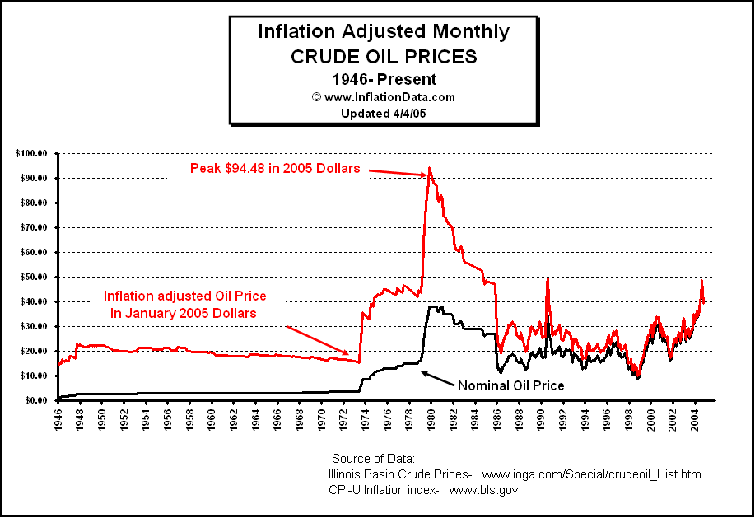
Now, I know what you're thinking - 'sure they seem high, but aren't they pretty low once you adjust for inflation' - OK maybe you weren't thinking that, but some people were, I'm sure of it. Anyway, this chart shows the historical price of oil in inflation adjusted terms and you can see that, aside from the spike caused by an arbitrary decision by OPEC to reduce supply in the 70's, oil prices are looking pretty high, even after adjusting for inflation.

Mahigan over at True North has a post up which looks at 'peak oil' and some of it's potential consequences. The basic idea behind peak oil is that one of these years were going to hit an all-time peak in terms of oil production and after that oil production will begin to decline (because we've already extracted so much of the easy-to-get-to oil).

In fact, there's little dispute that this will occur sooner or later but where people differ (besides the sooner vs. later part) is on what the impact will be.

On one side we have the optimists. While they don’t deny that we are beginning the long process of running short on traditional fuel supplies (oil & gas), they believe that human ingenuity combined with pricing signals from the market will ensure an orderly transition. Count Alan Greenspan among this group. Optimists will point out that civilization has made it this far without hitting any resources constraints and that every previous time people have predicted some sort of resource crisis, they have turned out to be wrong. Basically they figure that if supplies of oil and gas get short the price will rise and people will figure out ways for our economy to keep on running with less oil and gas.

On the other side are pessimists such as James Howard Kunstler (quoted extensively in Mahigan’s post) who believe that the coming oil crunch will cause a drastic change in our lifestyles with car-dependent fully-detached suburban living no longer being viable for the middle class in a world of sky-high fuel prices. The geo-political pessimistic viewpoint sees the war in Iraq as just one example of what is likely to become an ever more desperate and high-stakes battle among the world’s most powerful economies to secure their share (and more) of what remains of the world’s oil supply.

Besides optimism/pessimism, another way to look at the situation is from a demand/supply perspective. As we can see here, worldwide oil consumption (demand) has been on a steady upward climb throughout recent history. The pessimistic view says that as huge, developing nations like China and India industrialize, we can only expect this consumption to keep climbing even if oil consumption in the developed world were to level off or decrease due to increased prices. The pessimistic view acknowledges that higher prices will lead to cutbacks in oil and gas use, but figures that prices will have to go high enough to cause crippling economic conditions before any significant changes will be made.

The optimistic view figures that human ingenuity and resourcefulness will find ways for us to easily lower our consumption if this proves necessary (true optimists don’t think it will be). Reasons for optimism on the consumption side would be technological advances which allow us to do the same things using less oil and gas (hybrid cars, led lights, efficient appliances, better insulation, etc. etc.), the colossal amounts of energy we currently waste at the consumer level (leaving room for relatively painless cutbacks), the fact that Europe manages a competitive quality of life using much less energy than North America, and the decreasing energy intensity of the economy (ratio of energy used to gdp) which show that energy use is making up a smaller % of our total economic activity over time.

More attention is generally shown to the production side. Generally, we get energy either from oil, gas, coal, hydro or nuclear (wind, while growing fairly rapidly, does not meet a significant % of our energy needs, and is unlikely to ever get beyond 5-10% of total energy supply). At best, oil and gas will require us to undertake ever more expensive efforts to ensure a steady supply. For example, building massive terminals to receive gas from overseas or drilling for oil in remote/environmentally sensitive areas or undertaking the huge costs of pulling oil out of the Alberta tar sands. At worst, even these efforts will be inadequate and prices will continue to rise faster than inflation.

There’s no shortage of coal in the ground, but if you’re worried about global warming, or if you live in Toronto and miss the sky during the summer, or if you happen to know one of the (estimated) thousands of people who have died prematurely do to air pollution caused by coal, you may not be too excited about the world making a big switch back to (or even continuing to use) coal as a primary fuel. The optimistic view is that innovation will find ways to burn coal without releasing carbon (or mercury or anything else nasty) into the environment, but while progress has been made (especially with regard to acid rain) there’s still a lot more work to be done and no guarantee that it will be successful (at a reasonable price). Also, if you consider the history of energy use from wood, to coal, to oil to gas the historical trend has been toward sources containing less carbon, not more.

Nuclear power represents another option. Here is a good example of the typical argument made in its defence. The trouble is that nuclear power needs uranium as an ingredient and world uranium supplies are hardly unlimited. Also, nobody needs a reminder of how dangerous nuclear power can be (20 years later, Chernobyl remains uninhabitable), and while the recent overall operating safety record of nuclear plants is pretty good, it wouldn’t take many accidents to change that in a hurry. And given that we look forward to a world likely to contain more and more terrorist actors possessed of ever more sophisticated weaponry, is it wise to have such potentially catastrophic targets scattered around the countryside – especially in the vicinity of large cities?

Disposal of the waste remains an unsolved problem as well. Do you really trust these people to run a nuclear program which will be safe for the next 10,000 years?

At its root, my worry about nuclear is that even if humans didn’t make it, the planet would probably survive serious global warming or most other environmental disasters with it’s ability to support life intact. Radiation however, is pretty much hostile to life in all forms – and for a very long time. If we are to use nuclear power its use should at least be based on a fair economic comparison with other power sources. That is, the costs of nuclear plants should include waste disposal costs (for perpetuity) and, most importantly, they should pay for their own insurance (right now, the government has assumed the liability from a nuclear accident in order to make nuclear power financially viable).

The last remaining major source of power for Canada is hydroelectric. Personally, I feel that the government should be working towards an expansion of our hydro capacity. I know, it's a provincial responsibility, but one way to help would be to divert infrastructure spending away from projects which promote energy consumption (such as twinning the trans-Canada highway through the less populated parts of the country) and towards projects which will produce energy – for example, helping to fund a high-voltage transmission line between Ontario and Manitoba to allow Manitoba to build more hydro capacity and sell it to Ontario.

True, there are some concerns with hydro, especially native land rights and salmon runs, but we need to avoid letting the perfect be the enemy of the good on this issue, because there are no perfect solutions - not even close. It seems clear to me that the environmental impacts of (carefully designed and implemented) hydro are less than that of the alternatives whether they be nuclear, coal, oil or gas (see here, for a good speech on the topic).

As an aside, I remember my dad telling me the story of one of the older dams in the northwestern U.S. where, after decades of operation, plans had been made to modify the hydro station. But there was opposition from local groups because the plans would upset the local ecosystem which people really liked – the same ecosystem artificially created by the dam’s construction many decades ago.

After hydro, there is wind which, while now cost competitive, is limited in its potential scope and is unreliable as a primary power supply (since wind doesn’t always blow). Furthermore, after you factor in all the effort and materials required to build a wind farm, it takes a number of years before the wind actually generates enough energy to cover all the fossil fuel energy which was used in its construction.

Finally, there is hopeful thinking, innovation and niche applications. Solar, geothermal, tidal, biomass, etc. power have all come a long way in recent years but remain limited to narrow applications (e.g. off-grid applications such as marine lighting for solar, location specific development such as Iceland for geo-thermal). Whether they will ever develop to the point where they can actually substitute for fossil fuels remains to be seen.

People talk about hydrogen in this context, but hydrogen isn’t really so much a source of energy as a means of storing it. That is because it takes energy to produce hydrogen. An adequately efficient process for generating, storing, transporting and using hydrogen is yet another unsolved problem in the world of energy.

The optimistic view is, ‘look at all these alternatives we’re bound to come up with a good, safe, cheap replacement for fossil fuels, it’s only a matter of time’. The pessimistic view notes that in the last 100 years the only really large scale energy source we’ve come up with is nuclear and that has a whole lot of problems of its own.


Looking at the overall picture, I am somewhat ambivalent about our energy future, with respect to having enough energy to maintain a lifestyle with a similar level of comfort to what we have now. On the one hand, the problem of finding a suitable replacement for fossil fuels seems like one of the toughest we've faced yet and sooner or later they will run out. This site does a great job going through the various alternatives and explaining just why they are not up to the job of getting us away from our dependence on oil and gas. On the other hand, I do believe that, in the face of steep and prolonged price increases, we have the ability to deeply cut back our fuel consumption without having a severe impact on our lives. Furthermore, we can build more hydro and wind energy plants as well as building more nuclear plants, burning more coal, or processing more tar-sands fuel if that is all that stands between us and the collapse of our economy.

The two things I worry most about are a) the geopolitical impacts of nations squabbling over what remains of the world’s cheap fossil fuel inheritance and b) the economic impacts of fossil fuel price increases. Even though we can live with using less energy or produce more from other sources, our economy could still be destabilized by price increases, much like it was in the 1970’s. Fuel price inflation could cause central banks to raise interest rates even in a period of sluggish economic growth thus putting the squeeze on heavily indebted consumers whose debt as a percentage of their income is already at all-time highs. We’re (somewhat) less dependent on energy than we were in the 1970’s but more dependent on low-interest rates so it’s hard to know how this would play out.

Another worry is that, much in the same way that AIDS is a particularly nasty disease because it targets the immune system, an energy crisis is particularly nasty economic disease because any solution to our energy problems would be reliant on large amounts of fossil fuels to provide the resources to fund/power the development of the solution. The last oil crisis was caused by an artificial constraint on supply which lessened over time. The next oil crisis won't give us that alternative.

At any rate, the government is facing an energy issue from two sides: climate change and the Kyoto Accord on one front and ‘peak oil’ and rising oil and gas prices on the other. Luckily, both of these problems have a similar solution. The price of oil and gas needs to fully reflect the costs of depleting the world’s resources, the damage done to the environment and the transition costs which will be required as easily accessed supplies dwindle and prices rise. So for starters, the government should stop subsidizing fossil fuel generation and increase fuel taxes (yes, I know, political suicide).

Beyond that, the government should adjust its taxes/incentives/legislation (that means you – nuclear) to bring the market prices of various energy sources into line with their true long-term prices (including all the externalities). Also, the government needs to get (further) ahead of the curve in funding energy research to make Canada (more of a) world leader in the energy industries of the future. Finally, the government needs to turn its infrastructure spending from energy consumption to energy production, with the expansion of hydro power - the only proven source with reliable supply, no input price fluctuations, no risk of radiation damage and no greenhouse gas emissions – being a logical target.


Update: April 17 - Looking for more information on 'peak oil' related stuff? Try here for a *lot* of links.


------------------------------------

1 I showed the picture to my girlfriend and she figured the flowering branch probably made the view look nicer than it really is, but you get the point.

Labels: , , , ,

Tuesday, March 29, 2005

Canadian Government and the Three Bears

So I was thinking to myself that one of the most controversial aspects of government in Canada (and in most places), is whether government here is too big (papa bear gov't), too small (mama bear gov't) or just right (baby bear gov't) - but I don't really have a good sense of just how big the government of Canada is - especially in comparison with other countries.

Luckily, google was able to bring the relevant information to my fingertips within seconds via this UN site which is a collection of statistics compiled by people trying to compare the size of government across countries. Seriously, how did we ever find out anything 10 years ago?

Anyway, there's a lot of interesting data there and perhaps later in the week, if I get time, I'll try putting some of it in chart form, but for now, I'll pick out some of the highlights, from a Canadian perspective.

There are a few things we need to be careful of (actually there's a ton of things as you'll see if you read this summary of the UN's findings but I'm going to hit the high points):

1. Comparisons which look at central government spending will understate the size of Canadian government because we have a relatively large non-central (Provincial + Local) government segment (more on this later).

2. There are different measures used. Government consumption typically doesn't include cash transfers whereas Government Expenditure does. Government Expenditure is roughly equivalent to Total Tax Revenue, except total Tax Revenue tends to be lower since governments have other sources of income besides taxes (resource royalties for example). Revenue will also be lower than expenditure if the government is running a deficit (I know I'm stating the obvious here, but it's relevant later on).

3. When comparing rich and poor countries it is advisable to adjust for the fact that services tend to be much more expensive relative to goods in rich countries. Or to put it another way, labour is cheap in poor countries. Because government expenditures tend to be service-oriented/labour intensive, government spending - all else being equal - will appear lower in poor countries (because they're not paying their teachers and doctors and civil servants and policeman and soldiers very much).

-----------

OK, enough caveats, what do the numbers tell us?

Looking at consumption (which excludes government transfers) as at 2002, Canada had the 11th highest government spending out of a list of 24 'developed' countries. i.e. we were right in the middle, along with the U.S.

The lowest country was Ireland at 13.3% of GDP devoted to government consumption (perhaps reflecting the efficiency of having just one level of government?) followed by Switzerland at 15.2% and Greece at 15.8%

At the high end are Sweden (28%), Denmark (26.1%) and Iceland (25.1%).

Canada came in at 19%, while the U.S. was at 18.9%.

Interestingly, the UN researchers built a statistical regression model to look at the data they collected and determine what factors influence the size of government. What they found was that government consumption tended to be lower (as a % of gdp) in countries with large populations and higher in countries with large geographical areas. This makes sense if you figure there are economies of scale in many government services and that many services (such as road building for example) are more expensive per capita in sparsely populated countries.

Note that both of these factors work in favour of a relatively large government sector in Canada. As the report says:
"Thus, from the raw statistics, Canada appears, relative to its population, to have larger government than the United States. Taking into account the diseconomies of serving a small population dispersed over a wide area, Canada actually has a rather small government compared to that of the United States!"

note: they must have thought this was noteworthy since it merited one of only 2 exclamation points used in their entire 17 page report

Interestingly the results were different when they looked at total government expenditure (which includes transfer payments - i.e. pension plans, child benefits etc.). Here they found that the strongest predictor of government expenditure was how 'open' the economy was, where 'openness' indicated a 'globalized' country which was heavily integrated onto the world economy (low trade barriers, large number of exports/imports as a % of gdp etc.). As the report says,
"on average, governments of open economies spend a significantly larger portion of GDP and collect the additional taxes needed for this task."

The figures for government expenditure were only given for central governments (since they are not collected for many local governments) so I'll look at total tax revenue instead. I found two sources for this data (the UN, and the OECD), and while they were quite similar, they didn't line up exactly. I'll go with the OECD figures since they have cover a greater range of dates.

The Canadian government collected 31.9% of GDP in taxes in 1975. Looking at the data every five years, this figure climbed to a peak of 35.9% in 1990 before levelling off and gradually starting to decline to 33.9% as of 2002.

By way of comparison, the lowest figures in the OECD (2002) are Mexico (18.1%), S. Korea (24.4%), the United States (25.4%) and Japan (25.8%).

At the high end are Sweden (50.2%), Denmark (48.9%) and Belgium (46.4%).

Canada is similar to other countries with British roots with Australia at 31.5%, New Zealand at 34.9% and the U.K. at 35.8%.

Of course one thing we need to consider is the different deficits in different countries. For example Canada's revenue (33.9%) is 8.1% higher than Japan's (25.8). But as we can see here (scroll down), Canada was running a 0.6% of GDP surplus in 2002 while Japan was running nearly an 8%(!) of GDP deficit. So the truth is we were spending around the same, just that we were collecting the tax to cover it and they weren't. Similarly, when you factor in the deficits that most other OECD countries are running, you can see that Canada's spending is lower than the revenue figures make it look (of course factoring in resource royalties may have the opposite effect but I couldn't really find any figures on how big this effect is).

This also means that if Canada's tax take is lower as a % of GDP now than it was in 1990, plus we have turned a deficit of 3.4% (1989) into a surplus, then government expenditure has come down fairly significantly as a % of GDP in the last 25 years.

Now I know what you're thinking, how much of this reduction was reduced program spending and how much was reduced interest payments on our debt? According to the Fraser Institute (source OECD), government debt interest payments were 5.3% of GDP in 1990, and were down to 4.9% in 2000. They've probably fallen more between 2000 and 2002 (maybe to 4.5%?) but it still suggests that most of the change has come from reduced spending as a % of GDP.

The one final number I wanted to look at was the ratio of non-central government spending to central government spending. i.e. How big is the local/state/provincial government sector relative to the national one. As you can see from this chart, Canada leads the world in this category as one of 3 countries (China and the Netherlands Antilles being the other 2) where local/regional government actually outspends the central government. I guess it doesn't tell us much that we didn't already know - Canada is a very decentralized country. But at any rate, it's something to keep in mind next time you hear about the 'fiscal imbalance'.

But wait, you say, the provinces may spend money but the federal government collects the taxes and transfers them to the provinces so even though the provinces spend a lot they don't have control over their spending. So we really need to look at tax revenue collected by local/provincial governments vs. the central government. OK, here's the figures based on tax revenue. It's true that the ratio of local/provincial taxes to federal ones is lower than the ratio for expenditures but (with the exception of China) this is true everywhere - and even if you look at tax revenues Canada remains a world leader (now #2 behind China) in decentralization.


---

So, tons of numbers (which I really should put into some charts) but what does it all mean? Looking at the historical record, government spending is lower as a % of GDP now than it was 25 years ago. Also, just looking at the raw numbers, the size of Canadian government doesn't look out of place in any international comparisons. When you factor in Canada's dispersed population, its open economy and the fact that it's running a surplus instead of a deficit (not to mention the public pension system being adequately funded) Canada's government appears to be one of the smaller ones among developed countries. Given that it also has one of the world's most decentralized systems of government, our federal government can be seen to be one of the smallest in the developed world.

Or to put it another way, Andrew Coyne ended this lament on our high spending (written in 1994) by saying, "Switzerland and Japan can run a welfare state on a third of GDP or less. Why can't we?". So he should be happy to know that as of 2002 there is very little difference in total government expenditure between Canada and Japan and Switzerland and that government expenditure as a % of GDP in Canada is running right around 1/3 of GDP.

Or to put it another way, most signs seems to suggest that, in contrast to those who would suggest that a) Canada's government is an ever growing monster that is threatening to swallow us all, or b) Canada's government is getting ever-stingier and is callously dooming poor people to a life of poverty, the size of our government seems both stable and reasonable.

Or to put it another way, Goldilocks went to Sweden but the taxes were too high. 'This government is too big', she whined. So Goldilocks went to Mexico but her car broke down on the bumpy roads, her tires were stolen and the air was thick with smog. 'This government is too small', she whined. So Goldilocks went to Canada. "Ah, this government is just right", she sighed.

So how does the story end? I'm guessing some people will end it with:

Goldilocks fell asleep in the land of good government and while she was sleeping the left wing Papa Bear returned and ate her, dooming her to a life of ever larger government, stifling her incentives, curtailing innovation, trampling on her freedoms, spreading inefficiency and turning the country into Sweden. The End.

While others might end it with:

Goldilocks fell asleep in the land of good government and while she was sleeping the right wing Mama Bear returned and ate her, dooming her to a life of tax cuts for the wealthy, corporate oligarchy, environmental degradation and disregard for the suffering of the poor and unfortunate, turning her country into Mexico (with a stop in the U.S. along the way). The End.

For me, I agree that we can't afford to fall asleep, but I think we need to make friends with the baby bear. After all a mama or papa bear wouldn't eat one of its kid's friends would it?

Labels: , , , ,